How to Close a Commons with an Open License

There are some interesting paradoxes that arise from alternatives to copyright. I have seen a big push to license articles and textbooks with a CC-by license (free to use if you attribute the author) and to avoid the CC-by-nc (free to use with attribution and for non-commercial purposes). The licenses available at Creative Commons have their use. They are all equally important because each one addresses a particular purpose. I think that there are times to use CC-by and a time to use CC-by-nc. But there are still problems with just CC-by, even though I am a big fan of that and CC-by-sa (Share alike).

The motivation to work with a textbook should be that it is the best one available with an open license, not that it is the one textbook you will be free to one day make a profit from. I would like to see the proliferation of good work because it is good work: not the proliferation of a work because it is licensed in such a way that a private corporation can profit from it. There are too many companies locking down content in ways that make them less accessible to the public.

One company started out by promoting open textbooks and the Creative Commons. Next, they created and charged for a platform to deliver that content. Then they needed to expand their business and make a profit for their shareholders. That is when the problems came in – “sustainabilty.” The open textbooks were Creative Commons licensed as CC-by (you only have to attribute the work to the author). In other words, they could not profit from those books unless they pulled that license and that is exactly what they did. Fortunately, Saylor.org managed to pull down and re-host the textbooks with the truly open license and that other company no longer calls itself an open textbook platform.

I voiced concerns about this when I was on an OER board in California about 7 or 8 years ago, and what I found was that it was very difficult to talk to members of the OER community about the problems with profit – I came across as “anti-business” and was actually called a “Socialist” in a public meeting. I am not anti-business or even anti-profit – but I am vehemently for open access to information and, unfortunately, money can be used to guide, promote and eventually kill a work. This is what happens to commercial textbooks! Have we not learned anything about the limitations of the commercial market?

I understand the importance of the different licenses but it is ironic that the most open license can lead to the shutting down of public access to supposedly open work. David Bollier wrote in his posting, “The Commons, Short and Sweet” that copyright “…privatizes and commodifies resources that belong to a community or to everyone, and dismantles a commons-based culture (egalitarian co-production and co-governance) with a market order (money-based producer/consumer relationships and hierarchies).” And yet this is exactly what can happen with the CC-by license.

There are arguments against the NC license that warn that if I use that license, corporations won’t be able to put my work on a DVD and distribute it with their magazine. Well so what? Maybe I don’t want my work distributed with their magazine. The irony of the argument is that my digital work (which I create for free) will not be available to prop up a dying industry! I can’t think of one magazine that bundles DVDs with their product that wouldn’t sue me if I just started posting their articles and materials on my blog. My argument is not against the magazines or capitalism, but it is against locking my content down in their business model.

Michael W. Carrol makes the point that “Granting readers full reuse rights unleashes the full range of human creativity to translate, combine, analyze, adapt, and preserve the scientific record, whereas traditional copyright arrangements in scientific publishing increasingly are inhibiting scholarly communication.” But the problem with that is that scientific publications are so expensive right now that many libraries can’t afford to subscribe to them. How does giving the work to a commercial corporation for free solve that problem?

Aaron Wolf has an argument against  the non commercial license that goes “I doubt a network TV show, for example, would use a song licensed as CC BY-SA (other than by paying the creator under a regular copyright license), because they wouldn’t want to license the whole show under Creative Commons.” Who says that they would have to license the whole show that way? Where has that been litigated? Are there no other interpretations of the license? Who gets to decide?

Saying that something is not truly open because it is not open to economic exploitation is ludicrous in all the Latinate meanings of the word. If we value education, we need to encourage our governments to support and invest OER in the same way that they support the military or industry. Openness includes access – if we focus our resources on working with corporations for our OER, then we risk seeing the materials that are not as “sustainable” (that is, profitable) withering away. We also risk having the openly licensed materials getting locked up behind “platforms” and “services.” And what happens when those corporations go away? Or get a new board not as hip to openness as the current one? I appreciate the efforts at the California State University system and the community colleges in creating and promoting OER and Open Textbooks but I would like to see more of a national/international effort that values access over profit.

Open Passage

This is my kind-of, mini-reflection on #OpenEd17. The conference is still going though, so I am jumping the gun a bit.

Last year at my 1st Open Ed conference, I didn’t know anyone. This year, I am lucky to have lots of friends here. But open educators are open people. It hasn’t been this easy to make friends since grade 3. I even broke the toot barrier with my roomie, Ken Bauer, who I met at last year’s conference. I’m sure he heard it… I’m sure he heard them. I didn’t hear any from him, for the record.

But those unlucky souls who do not yet know about Open Ed do not know how nice it can be in our community. So they won’t come in without a pull.

Now I know it’s probably obvious, but I want to say it anyway. #OpenEd17, the real work of this conference starts now. I know you do this already. This is really just a message from me to me. A reminder to take it from here and pass it along. Or try to pass it along more anyway.

We all got some great tips, and tricks. Some ideas for new things to try. New resources we didn’t know about that are slicker than snot. We’ve recharged our excitement for Open Education. But it’s a little bit of preaching to the choir after a while. What’s more important to do next than going out and trying to convince someone who doesn’t know anything about Open that it’s something important?

It’s a lovely group, but let’s go meet more new friends now and tell them about this stuff.

The most effective activity at the conference, for me, was the speed networking during the unconference (Thanks, Rolin Moe, for cajoling us into it). Not only because I met so many people, but also I worked my “who am I and what is open to me” spiel 5 or 6 times and now I feel much more ready to say it to anyone. I have my open passage more readily available at the tip of my tongue. Now I’m more likely to pass it along.

So how about this idea? Anyone who prepared and delivered a session here in Anaheim, try to deliver the same or similar talk at another conference. One full of not-yet Open Educators. Or write a post about your time here, but make sure to send it to places away from us to colleagues who don’t follow Open Ed (and towards us, too. We still want to read it!). Have your open passage at the tip of your tongue, ready for anyone.

Whatever you do with what you took from these days, pass it along more so than pass it back to us. Let’s not stand in a circle and say what we’re saying back to each other again and again. Turn around and say it to someone new. Talk to some students! It might be kind of uncomfortable, like making a sales pitch. Try. Make sure to listen to what they say in return, too. It’s not passing the baton, it’s passing the salt and pepper. You probably already do this but I want to say it.

Maybe someone new will break the toot barrier with you at next year’s conference. Fingers crossed.

image: “saltshaker showdown” flickr photo by athrasher https://flickr.com/photos/athrasher/15746721477 shared into the public domain using (CC0)

Paying it Forward with Creative Commons

Have you ever found yourself sitting in the Starbucks drive thru and you pull up to the window only to find out the person in front of you has paid for your order? What exactly did they get from this transaction? Certainly, they were not paid or rewarded with anything tangible, but they probably did receive a feeling of happiness that comes along with paying it forward. What if that same feeling of paying it forward could be applied to OERs and creative commons?

This week, in the edX MOOC: Introduction to Open Education, there is a focus on Copyright, the Public Domain, and the Commons. While reviewing this module’s videos a concept really stood out to me: the concept of different types of transactions earned from OERs and creative commons, other than monetary transactions. In the third video presented this week, George Siemens (2017) asks, “shouldn’t someone who creates content earn money from it?”

Siemens (2017) then begins discussing the concept of different types of transactional entities such as recognition or exposure received from a published work. As an individual that is trying to build their career in higher education, specifically educational technology, I find that this type of transactional entity is exactly why I take no issue in producing content or artifacts for “free.” Siemens (2017) also talks about another form of transactional entity which is just fueling the thing you are passionate about, for example, volunteering at an animal shelter – you aren’t being paid with money but you are paying yourself with the satisfaction and internal fulfillment by offering your time and effort. Creating and distributing OER’s is just another form of volunteerism, specifically for the educational community – you create it because you are passionate about sharing knowledge and building on the current foundations of ideas.

So with all of this in mind, why is it that so many academics are still hung-up on the need to have their work copyrighted without offering creative commons? As an academic myself, I can understand the desire to share ideas with my fellow academics, as well as earning some coin in the process. However, I understand that by not allowing my work to float along in the world of creative commons I am stifling my ideas as well as the ideas of others who may use them as building blocks in the future.

While I understand the need to put food on the table and provide your family/self with a sense of financial stability, does only creating content for the sake of monetary transactional entities go against everything academics stand for? Is there a happy middle where content can be created and more than one type of transactional entity can be obtained?


References

Wiley, D., & Siemens, G. (2017). Copyright, The Public Domain, and the Commons (part 3). Retrieved from https://courses.edx.org/courses/course-v1:UTArlingtonX+LINK.OEx+3T2017/courseware/92ac80880b244befbb4ebc69391a7755/937f64e5eb774acab948d2090e9e558a/?child=last


Applying OER to Design

What does OER mean to me as an Instructional Designer (ID)? Pretty much everything. I frequently say to my colleagues, “we’re better in numbers”. By the end of the first week of Introduction to Open Education edX MOOC, I feel that I may have found my tribe who embodies that concept. I love communities of practice and actively seek ways to create and support relationships in design. I feel like OER has connected my beliefs on sharing, communicating, using crowdsourcing to improve and critique designs and technology, developing relationships, creating creative resources and ensuring licence compliance.

As an instructional designer, I’m constantly creating, utilizing, and citing media resources to embed in online learning spaces. These online courses are never complete because content is constantly evolving. If education is knowledge transfer, or fundamentally education is sharing, then (as an ID) I’m in a unique position to help deliver the expertise of the course author/SME into an engaging and meaningful design for students to contribute to the field. If design is an iterative process, then collaborating and receiving critique from peers is one way that design could enter the world of OER. In addition, I actively consult faculty on technologies, media and resources to embed in online courses. Once we determine course materials and resources, I work through the copyright, commons and public domain process to determine how to share resources in a course. It can be quite an arduous (and long) process!

I enjoyed the first week of the course and appreciated the large scope to cover all types of education resources (ie. curriculum, pedagogy, code, technology tools, etc.) and not just textbooks. As someone who likes to take knowledge and put it into practice, I’m actively designing a course that will only use OER. Can’t wait to share!


The trap of copyright

I liked Wiley’s description of the current copyright situation as a trap (“it can feel really trapping”, 8.24′). Much of what sounds intuitively reasonable is prohibited when a copy of knowledge is treated as economic ‘property’ despite it just doesn’t fit this category in many ways (e.g. the copy is no longer a scarce value, and you can’t inspect it before purchase, you cannot return it and ‘unknow’ it, and so on).

Photo: Trap by Flickr user aydun cc-by

In practice, many try to ignore this trap. For example, when they use the ‘work’ of a textbook image in their course, they often confuse quotation rights with work use rights: if they don’t “critically engage with” the quoted part, they don’t qualify for the former kind of right. Which is meant to apply to an idea which is usually not protected against exploitation but to be tracked for credit and validity. By ignoring this, they won’t notice just how much the trap impedes their teaching even behind a Moodle wall.

Others try to argue ideologically or emotionally, by equating all IP: the rights of a small painter (who makes a living with his works) to the work of a tenured person who writes their books “on their own time” — which nobody dares to critically distinguish from his total time outside the classroom.

But most authors seem to put up with the trap. The prestigious journal is dictator, and they have learned (during their many years as adjunct slaves) that resistance is futile? Wiley has great responses to such kind of senior faculty:

“the only people tying us to the old system is us.”

and

“science advances one funeral at a time.”


Filed under: OpenEdMOOC

Why Open Education Matters

Open Education is about reducing barriers to education. The movement tackles and empowers questions of cost, access, and power as related to the delivery of knowledge or as I prefer to frame it, the facilitation of learning.

Open education matters because “education is the cornerstone of liberty” (Eleanor Roosevelt). Because “everyone has the right to education”, “shall be free”, and “accessible to all” (Article 26, Universal Declaration of Human Rights). 

Open educational resources (OER) are openly licensed (most commonly through Creative Commons) to enable creators to retain copyright while licensing and stating endorsement of remix and reuse of their content.

Cost. Textbook costs are a leading driver behind the open education movement in North America. Open content such as textbooks reduce costs to students and provide instructors the opportunity to customize their instructional material and practices.  However, the challenge of textbook costs is not necessarily the core reason for all stakeholders, nor the primary benefit on a global scale.

OER such as open textbooks reduce costs to students and provide instructors the opportunity to customize their instructional material and practices. By releasing constraints of the learning material, the power shifts from publisher to the instructor.

Power. The fact that openly licensed content can be a linchpin to unlock freedom and creativity in the classroom and empower instructors and educational systems alike to address the considerations of power dynamics in educational settings in a tangible way is nothing short of revolutionary. Sharing of one instructor’s knowledge, teaching practice, and experiences progressively alleviate the competitive culture among educators and scaffolds collaborative practice. As instructors explore how the use of OER can empower their own teaching practice, their engagement with students, and the students’ engagement with learning material, there is an opportunity for yet another shift in power: from instructors to students.

The practice of open pedagogy (aka OER-enabled pedagogy, aka open educational practices) is defined in various ways that are influenced by studies in critical pedagogy and democratization of learning. Simply using OER in place of a textbook and other proprietary learning material opens the door for student agency in how their consume this material (for example, students may re-format the content in a way that is more palatable to their learning style), and provides the opportunity for non-disposable assignments, also called renewable assignments (Wiley).

“The true power of open comes not from a resource being free of cost but rather from the freedoms to reuse, retain, redistribute, revise, and remix content. These freedoms empower both students and faculty while widening access and supporting the democratization of education.” (Jhangiani). 

In the context of global and societal impact, OER and the Open Education Movement is positioned to enable further decolonization of educational materials by decentralizing the ownership, edit rights, and use. Localization of content allows educators to increase relevancy and ensure inclusivity. By publishing educational material “in the open” with open licensing, global perspectives are increasingly accessible and available to both formally enrolled students, informal, and lifelong learners.

Access. Open access (OA) is of major influence to the open education movement. Although research journals are differentiated from open educational resources or educational material, the development of OA is integral to open culture and the adoption of open educational practices. OA addresses the barrier of access imposed by traditional research publishing. Creating the systemic change toward open access journals is a developing landscape. As an example, the Tri-Agency Open Access Policy on Publications mandates funded research to be openly licensed within one year (simplified here). The more open educational policy is developed and reinforced, the more frequently we will see open practices recognized in the academic culture and ultimately, an expected norm.

Open Education also benefits accessibility (the design of products, devices, services, or environments for people who experience disabilities) and accessible education (the process of designing courses and developing a teaching style to meet the needs of people from a variety of backgrounds, abilities and learning styles) by allowing content creators, instructors, and students to customize resources freely to meet their unique needs.

In closing, open education matters because it is one of the solutions to address barriers to education (cost, access, power, and more). It is our responsibility as educators to address these barriers and create equal and equitable access to education. 


#OpenEdMOOC Week 1

2017-10-10_1838Though signed up to the EdX Course in good time, I’ve only just today, already half-way through week 2, gotten around to exploring the resources and activities for Week 1 of George Siemens’ and David Wiley’s (or is the attribution the other way round) open course on an Introduction to Open Education (hashtag #OpenEdMOOC).

On first viewing, the structure is interesting. The course is available as an xMOOC (with the possibility of an optional certification) on the EdX platform. In this version, there are weekly exercises, that are assessed  — I’ve missed the deadline for the first one — and the usual mixture of text, video, readings and discussion. This version will cease to be available, shortly after the course ends, unless the $59 certification fee is paid by the end of October. But there is also an xMOOC version, made available under a CC BY licence at URL linkresearchlab.org/openedmooc, with largely identical content.

So my initial question is why did George and David chose to present their course on Open Education in a format that is “Open” only in the sense of free to register and also in the form of an Open Education Resource that satisfies Wiley’s 5Rs that come up in week 3. Another question that will be interesting to reflect on later, is where will the most useful course discussions take place? In the walled garden of the discussion boards on EdX (analogous to an institutional VLE) or in the wider network?

Personally, I expect to remain at least one week behind, so I already know that I’m likely to find the xMOOC version of the course more accessible. I also expect most of my contributions to be made via this blog and any discussion to take place on Twitter.


Copy rights and the encouragement of learning

This week’s work on copyright in the OpenEd MOOC should ring a bit of a historical bell. James Boyle’s chapter on Jefferson (assigned reading for this week) does a great (and lengthy) job analyzing the various positions of the founders, and European intellectuals of that time, on copyright. (I did find something a little more succinct here.)

Although Benjamin Franklin, having earned enough on his inventions to retire at a young age, apparently didn’t patent or copyright his work, other founders were most vociferous in their support of copyright. Without much debate, it was put in the Constitution (Art. I, Sec. 8, Cl. 8):

“the Congress shall have power . . . to promote the progress of science and useful arts, by securing for limited times to authors and inventors the exclusive right to their respective writings and discoveries.”

But apparently this wasn’t enough. By 1790, there was a Copyright Act, called An Act for the Encouragement of Learning, by Securing the Copies of Maps, Charts, and Books to the Authors and Proprietors of Such Copies. Note the language: the encouragement of learning. The idea was to encourage authors and scientists not to keep it to themselves – to share. Since, as I teach my students, there is no reason for a law unless people are doing the opposite, this encouragement must have been needed at some level.

So one can assume there was a dearth of publications in the new country.

Interestingly,  the acts themselves were clearly copied from England’s own copyright laws (the Licensing Act of 1662, the Act of Anne in 1710). I wonder whether they cited these?

Jefferson’s letter, which seems to oppose copyright but actually proposes a short, socially agreed-upon copyright, was written in 1813. By then, there were significantly more publications and Jefferson, who did not make his living with his writings, was sharing his complex opinion on the subject (all the founders were complex intellectuals – it’s actually difficult to peg most of them to a “position”).

So on to now. Let’s say the original reason for copyright was because there were too few ideas out there. We do not have a dearth of ideas now. Some of them, of course, are heinous yet available to all through the medium of the web. So let’s hold them to the standard of the 1790 law: does copyright today encourage learning?

Open education, open sources, open access – it seems to encourage more learning than something as restrictive as copyright. Jaron Lanier, author of You Are Not A Gadget,  would disagree. In fact he does, here in this interview and elsewhere.

Lanier sees that what seems to be free and open can be detrimental to society as well as to creators who are not paid for their work. But someone is getting paid, and getting paid a lot, in the sharing economy: companies like Facebook, Google, Amazon. They are benefitting from the labor of others: “ordinary people are expected to share while a few companies at the center get all the money”. The solution?

I would like to see more systems where ordinary people can get paid when they contribute value to digital networks; systems that improve their lives and expand the overall economy.

Right now, I’m contributing to something. For free. Sharing what’s in my head (whether Boyle’s sources see that as natural, or even mine, has been debated). I benefit from others doing the same. But Lanier’s point of view makes me wonder: who else is benefiting from my work?

I agree with Lessig and others who say copyright should not be perpetual, and with the founders that it shouldn’t be for long. Extension of copyright beyond the lifetime of the creator has always seemed ridiculous to me.

But Karl Fogel’s article claims that copyright was never about creators or jobs, but about publishing rights and vendor claims. Intellectual property law was created by and for business interests, not starving artists. He suggests copyright is doomed anyway:

The abolition of copyright law is optional; the real force here is creators freely choosing to release their works for unrestricted copying, because it’s in their interests to do so. At some point, it will be obvious that all the interesting stuff is going on in the free stream, and people will simply cease dipping into the proprietary one.

In the academy, it remains very difficult for ones work to be taken seriously unless it’s published in a proprietary, copyrighted journal. While I am aware of trends toward more open sharing of ideas and science, I am unclear as to how one would actually reach an audience without those nasty publishing types.

So I’m considering things in a different way, as small and large markets for knowledge. One possible historical argument might claim that in the past (17th-18th centuries),  there were not enough ideas in published circulation, so it made sense to give legal rights to those who were willing to publish under condition that their ideas be attributed to them and not claimed as original by others. They were reluctant to share their ideas, inventions, stories, without that assurance. Publishers could expand their reach and markets, making a large profit for doing so. Thus authors and artists have always been at the mercy of business, at least if they wanted their ideas widely accessible.

Now, the argument goes, everything is widely accessible via the web. So we don’t need copyright and we don’t need publishers. I think this leaves out a crucial piece: access to the appropriate market. I “publish” freely on this blog. I pay WordPress.com for the privilege of not having nasty hackers hog CPU percentage on a rented server (the reason I had to leave off blogging in my own installation). Since they are “out there” on the web, my ideas presumably have a large potential audience. But my blog does not have many readers. Traffic peaks during MOOCs and such, but I rarely get more than 40 readers in a week, and most only stay for a few minutes until they figure out my blog isn’t what they wanted to read. I’ve never particularly cared, since I don’t really write for an audience.

But let’s say I wanted to do that, reach a larger audience, perhaps even get paid for doing what I spend so many hours doing. Would I value copyright? You bet I would. I’d need those evil publishers, who have connections to readers beyond my measly scope. The learning that I want to encourage simply won’t be seen by many interested parties unless I use the system, and I won’t be able to benefit much financially if I don’t.

Why? Because it seems to me that openness as a way of serving ideas benefits those with access to that which is not open – those with PhDs, connections to businesses, government grants, and/or startup money. And Lanier is right – it does it by using the labor of people like me. I am a “free” student in this MOOC, since I’m not paying EdX and the University of Texas for a “verified certificate”. George and David have done what I do for students, putting up readings and videos, but quite a bit of content is expected to come from us free participants. When I search around about this MOOC, I see corporate sponsors, and Gates grants and things, and research. Someone is making money. It isn’t me. Perhaps I am a rat in the lab?

Or am I a member of the commons? I have thus far used Creative Commons on all my lectures for my classes. But I am rethinking. In medieval times, the commons was used by everyone, but it was owned by the lord of the manor. On the web, this landlord could be Facebook and Google (as Lanier notes), or my ISP, or WordPress.com. But unlike a peasant on a manor, the sheep I’m tending in their field really are mine. (Yes, they derive from the sheep of others, as all do, but they are mine.)

Exploring these issues, even after 20 years in online teaching, makes me more uncertain, not less, about what’s going on. And that, at least, has encouraged my learning. It may also encourage me to copyright my work.


Why Open Matters #OpenEdMOOC

This one sentence really grabbed me from the readings: SPARC – Open Education

Technology holds boundless potential to improve teaching and learning. Open Education ensures that teachers, learners and institutions can fully explore this potential. 

It reminded me that I wrote an open educator manifesto over 6 years ago. In the spirit of this quote from the same article:

“Open” permissions are typically defined in terms of the “5R’s”: users are free to Retain, Reuse, Revise, Remix and Redistribute these educational materials.

  1. Retain – the right to make, own, and control copies of the content (e.g., download, duplicate, store, and manage)
  2. Reuse – the right to use the content in a wide range of ways (e.g., in a class, in a study group, on a website, in a video)
  3. Revise – the right to adapt, adjust, modify, or alter the content itself (e.g., translate the content into another language)
  4. Remix – the right to combine the original or revised content with other material to create something new (e.g., incorporate the content into a mashup)
  5. Redistribute – the right to share copies of the original content, your revisions, or your remixes with others (e.g., give a copy of the content to a friend)

I’d like to put this out to be reworked and revised. Not necessarily even what I wrote, but perhaps the ideas of Dean Shareski around being a giant derivative and having a moral imperative to share… and Alec Couros on Open Teaching or Networked Teaching. (Links all below).

I love the simplicity of the Remix Manifesto.

Can someone take this 6 year old Open Educator Manifesto and make it both simpler and better?

April 12, 2011:  My Open Educator Manifesto

[Version I: Just the Manifesto]

My Open Educator Manifesto

‘We’ educate future citizens of the world

Teaching is my professional practice

I Share by default

I am Open, Transparent, Collaborative, and Social

My students own their own:   (Learning)

• learning process

• learning environment

• learning products

• learning assessment

My students belong to learning networks

Every student deserves customized learning

• Student voice

• Student choice

Every educator deserves customized learning

I have high expectations

I Care, Share, and Dare

I am a role model

I am the change I want to see in Education!

______________________          ____________________          ____________________

Chris Kennedy asks:

How do we move from being a connected network to becoming a group of influence?

How can we aggregate our thinking in a way that has influence in the larger community?

In response to my comment, Chris says,  (& I’ve added emphasis & links…)

“… I think we (those inside the system) need to come to some agreement on what we believe and want – in thirty seconds be able to explain what schooling could / should look like. We then need to find ways to take this out to the larger community in a coordinated way.

Here is one you might have some thoughts on – What is the new “product” we use to share our thinking. The old way was we would produce “white papers” or “thought papers” on a topic and circulate it in the community and maybe create some sort of one-way feedback. Is the new way a website like Born to Learn, is it a video like New Brunswick did, is it a multi channel approach. If we actually can agree on some basics pieces – almost universally in the province about the system we desire what is (are) the vehicle(s) we use to share it. When I hear people are commissioning a “paper” on change I just don’t think that is going to do it.”

My blog is not the new “product”, but it is my starting place. I’m not sure what the ideal venue will be?

The manifesto above, by itself, is a 30 second explanation of what schools and education could be like. Here is the manifesto again, with some ‘discussion’ added. Hopefully others will share their thoughts and their manifestos too. However, please note: as Dean Shareski says, “I’m a giant derivative… I won’t pretend that I’m going to share something new and original. That’s really hard.”

… And in fact, I remember reading some great Manifestos on Steve Hargadon‘s School2.0 wiki years ago. I even wrote a Participant’s Manifesto a while back, to look at what I think is an underutilized aspect of learning: the responsibility of the learner! Other influences to this post include Subbaraman Iyer’s “The education and learning approaches” and Jennifer Dalby’s “Down in Front“.

This manifesto is my attempt to ‘agree on some basic pieces‘. I hope this is a conversation starter.

______________________          ____________________          ____________________

[Version II: With explanations, multimedia, and links added.]

My Open Educator Manifesto

‘We’ educate future citizens of the world

“The goal of education is to enrich the lives of students while producing articulate, expressive thinkers and lifelong learners, who are socially responsible, resilient, and active citizens of the world. Education is about teaching students, not subjects. It is about engaging students in their learning, and maximizing the potential of each and every child. Education is about looking beyond the child’s intellect, and seeing the whole child. Education is about providing students with opportunities to be challenged and still succeed.” (Link)
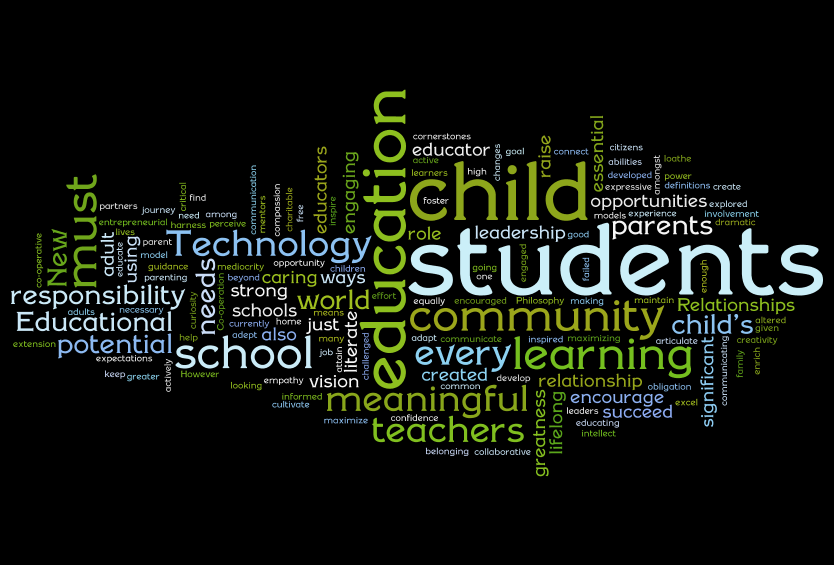
"Statement of Educational Philosophy Wordle ~ by David Truss"

“It takes a village to raise a child” and so ‘We’ must communicate, collaborate and coordinate opportunities to authentically work together. We must meaningfully cooperate with all stakeholders in education. Parents (and grandparents) are our partners in education. Businesses are not just future employers, but intellectual and financial stakeholders too. Teacher, support staff, and student unions all have a say. So do school boards and elected officials. ‘We’ can only find success in being open to cooperative ventures and adventures with the common goal of being in and of service to our children. After all, we all want the same things!

"What I Want For My Children ~ by Heidi Hass Gable ~ CC = BY::NC::SA"

Teaching is my professional practice

I have a responsibility to be current, and I must prepare my students for an unknown future, where adaptability and creativity take precedence over ‘book’ knowledge.

"Did You Know - Shift Happens ~ by Karl Fisch and modified by Scott McLeod" "Sir Ken Robinson ~ Do Schools Kill Creativity? ~ TED Talk"

We practice teaching. “We have an obligation to do our best, but that will ultimately change as we… practice. If we want to apply ‘best practice’ to teaching, then we need to look at ourselves as role model learners. We need to be relentless learners striving to be our best. We need to be self-reflective… We need to ‘practice teaching’ to the best of our ability.” (Link)

I Share by default

I am copy-left "Attribution-NonCommercial-ShareAlike 3.0 Unported (CC BY-NC-SA 3.0)", not copyright. In the words of Dean Shareski, ‘Sharing is a Moral Imperative‘, “I’ve been blessed to work as part of a larger community of learners, teachers, explorers and innovators who, in the spirit of sharing have thrown their ideas onto a giant whiteboard for others to use, critique, and mash up.”

"Sharing: The Moral Imparative ~ by Dean Shareski ~ CC = BY::NC::SA"

I am Open, Transparent, Collaborative, and Social

As Alec Couros defines Open Teaching: “Open teaching is described as the facilitation of learning experiences that are open, transparent, collaborative, and social. Open teachers are advocates of a free and open knowledge society, and support their students in the critical consumption, production, connection, and synthesis of knowledge through the shared development of learning networks.”

"Open Teaching - Thinning the Walls ~ by Alec-Couros ~ CC = By::NC::SA"

Open:

When we reflect openly, we gain greater insight, and learn more. (Link)

“Being “open” unintentionally changes us so that doing things in new ways isn’t just a possibility, but a necessity and a convenience. To me these are two key point in why social media is changing education:
Necessity – Being open makes us more reflective educators.
Convenience – Being open creates opportunities for anytime learning, beyond the confines of classrooms and schools.” (Link)

Transparent:

“It mattered that I was publishing my daily agenda to the world on the front page of this wiki. I was keenly aware that things went slower than I’d hoped, that I was winging it as I learned to use a wiki at the same time as my students, that I was asking them for public feedback, etc. … Teachers are forced to be more reflective when they are open. When I started to open my classroom and share what I was doing with parents, and the world, I thought more about what I was doing and why I was doing it. My practice changed.” (Link ~ Same post as the ‘Open’ link above.)

Collaborative:

“The Interesting Ways series continues to be a great example of crowdsourcing good quality classroom ideas and it has been a privilege connecting with all of the people who have taken time to add an idea. It is remarkable what can be achieved and created together if you give people the right way to do it.” (A collaborative project created by Tom Barrett)

Social:

Are you a networked teacher? What Does the Network Mean to You? (by Alec Couros)

"The Networked Teacher VoiceThread ~ by Alec Couros"

My students own their own learning

a) Learning Process: A metaphor to help guide us is“…the teacher as the compass. We point in a direction, (not necessarily the direction that the student is going), and we are a reference point or guide to the learning.” (Link)

“What happens when you: Allow students to determine what they need to learn, and then enable students to manage their own learning activities? (Link)

b) Learning Environment: We need to create shared learning spaces for our students. “I think that our idea of where learning happens has made a fundamental shift from book knowledge of the last century to anywhere/anytime information access of today.” (Link; cartoon below: Link)

"School Limits ~ by David Truss ~ CC = BY::NC::SA"

c) Learning Products: “We don’t own a student’s learning; It’s their learning. Whenever possible we need to be thinking about how we can provide students with an archive of their work… and that has to include the conversations (or comments in the case of blogs) and the hyperlinks that made the learning experience richer and more desirable to keep.” (Link)

d) Learning Assessment: Marks do not equal Assessment. Grades are numerical while learning is anecdotal. Assessment is not the end of learning, it is an opportunity to provide feedback which can be acted upon to improve achievement and student success. Assessment should be ongoing, frequent and completed by teachers, by students and by teachers with students.

Why have letter grades? See Joe Bower’s Grading Moratorium! According to Alfie Kohn, ‘From Degrading to De-Grading’, “In my experience, the most impressive teachers are those who despise the whole process of giving grades.  Their aversion, as it turns out, is supported by solid evidence that raises questions about the very idea of traditional grading.”

My students belong to learning networks

Students are nodes in each others learning network. A network of learners is fundamentally different than a group or a single classroom.

"The Networked Student ~ by Wendy Drexler" "Web 2.0, E-learning 2.0 and the New Learning ~ by Stephen Downes ~ CC = BY::NC::SA"

Networks also encourage a larger, more legitimate audience for student work. “Being open, and sharing your work and student work online, invites an audience and an authentic audience matters!“

Every student deserves customized learning

a) Student Voice: As Erica Goldson says, “We are more than robotic bookshelves, conditioned to blurt out facts we were taught in school. We are all very special, every human on this planet is so special, so aren’t we all deserving of something better, of using our minds for innovation, rather than memorization, for creativity, rather than futile activity, for rumination rather than stagnation? We are not here to get a degree, to then get a job, so we can consume industry-approved placation after placation. There is more, and more still.” (Link)

b) Student Choice: No two learners are alike. We make accommodations to meet a learner’s needs (and interests). We create projects based on learning outcomes that we want students to achieve. Project criteria does not dictate what students must do… learning outcomes are what we want to achieve, not marks on a project. ie. We don’t ‘do’ movie projects, we do projects where a possible learning artifact might be a movie. Our students deserve to demonstrate their learning in ways meaningful to them.

Every educator deserves customized learning

“We” are not all alike either… Educators are learners too. “I think there needs to be a recognition that we aren’t in the ‘teaching business’, rather we are in the ‘learning business’, and if we aren’t constructing a teaching model that supports teachers in their learning then we need to redesign what a teacher’s day looks like!” (Link)

Teachers need learning to be embedded into their day. They need: (Link)
1. Time- Pro-D, preparation, planning & play
2. Co-teaching & collaboration opportunities
3. Models & Mentorship

I have high expectations

I expect great things from my students and from myself. When I create the proper environment, and set high expectations, students will often exceed those expectations. I have high expectations for behaviour, work habits, discussion, participation, and achieving learning outcomes.

My expectations are high, but attainable, and they are developed with students’ abilities in mind.

“I make kids work harder than they ever thought they could.
I can make a C+ feel like a Congressional medal of honor
and an A- feel like a slap in the face.
How dare you waste my time with anything less than your very best.”
~ By Taylor Mali

I Care, Share, and Dare

I am Caring: My students are first and foremost important individuals in our learning community.  They need to be respected and respectful, nurtured and nurturing, given a voice and listened to. I can be firm, I can have high expectations, I can be demanding, but through it all I have let me students know that I care about them and want what is best for them.

I am Sharing: Of my time, my resources, my knowledge, my questions, my challenges, and my (two-dimes worth of) thoughts. I have obligations beyond my classroom, to my school community, my personal community and my learning community. I inherently know that through openly sharing, I benefit from the reciprocation my sharing invites.

I am Daring: I try new techniques and transformative new tools. I give students: Choice; A voice; An audience; A place to collaborate; A place to lead; And a digital place to learn (and play).

I am an Edupunk, and/or I support the DIY educators that are leading the way, and/or  I break the rules, and/or I do not go quietly into my classroom, and I am an agent of change… I am innovative in my practice. I will make mistakes, I will fail, because I know that if I don’t, then I’m not trying hard enough!

"A Brave New World Wide Web ~ by David Truss ~ CC = BY::NC::SA"

I also expect my students to  Care, Share, Dare!

I am a role model

I have a great attitude towards teaching and learning. I am an engaged and enthusiastic teacher and learner. I treat my face-to-face and online connections with dignity and respect. I have a great digital footprint. I care about my family and my community. I care about my school. I care about those in need, and I stand up to injustice. I am tolerant, forgiving, respectful, kind and courteous. I feed the good wolf within me.

I am the change I want to see in Education!

______________________          ____________________          ____________________

…And now it’s your turn!

Share your thoughts, share a manifesto, share a link… participate.

Are these things we can agree on? What can’t we agree on? What’s missing?

Please join the conversation.
Openness, Humanness, and Connectedness: or We can connect in the Open if you want to

In my last blog post I responded to the question “why does open matter” posed by #OpenEdMooc with the answer “because we are human” by proclaiming that open mattered because humans have a need to connect and because openness facilitates connectedness.

I came across an interesting response to my post from Benjamin Stewart that I did not notice before because Benjamin posted it as an Evernote note which I did not get a notification on but I did notice when he posted it to twitter. Benjamin asks if I’ve gone far enough in my thinking. He gives an example that one can connect without being in the open and gives examples of connecting through a clique or a closed group of like minded individuals.  

I appreciate the question – it makes me wonder about how open is open. Can one be open within a clique? Can a closed group have diverse minds? Then I start thinking about Blake and the doors of perception – about how I’ve argued that the doors are more than just open or closed but of many differing natures and states (glass doors, murphy doors, pocket doors… being propped, locked, ajar, and I could go on). But again I’ll stop myself from going down the rabbit hole as this post will be much longer and go in a different direction if I do.

Trying to stay somewhat short and on task I’ll address Benjamin’s concern by simply restating that it is my premise that open matters because are human. To extrapolate further – humans have a need to connect and openness facilitates connectedness…. however, I am not stating that humans have a need to connect in the open. I think that Benjamin is absolutely correct when he says that people can connect in closed groups. I would actually take it further and say that people will connect in closed groups. This is not antithetical to my point – I think that it actually makes my point.

I’m not one of those who demonize this closed connectedness – I think we need that too, though too much of it can be a problem. I see the problem with it as one of scale more so than it being an issue in the thing itself.

As we enter week 2 of #OpenEdMooc we are starting the conversation around copyright and how that plays with Open. The problem around Mickey Mouse and copyright has come up because here in the US every time the threshold of public domain draws near to Mickey going into the commons lobbyists petition the courts and the date is pushed forward another twenty years. Of course this does not just apply to Mickey but to all copyrighted works.

We don’t have to connect with Mickey – but if we wanted to – well it has to be one way and at a premium.

We don’t have to connect in the Open – but we can if you want to.

But we do have to connect.

Humans need to connect. With ideas, with one another, with language, with images, with emotions, with numbers, with color – I could go on. Extreme cases of humans being deprived of connections are abusive atrocities but lesser barriers are always going to exist. You can connect within closed systems or you can connect in the open but I think most people mix it up depending on your definition of ‘Open’. I like to connect in both in the broad sense; though when it comes to education I tend toward Open when I can. There are some for whom connecting in the open may be their only option because of money or other circumstance. So, when I think about why Open matters – I’m sure there are lots of reasons, but still, I say it is because we are human.