‘Text’-book ?

I am no longer on a campus and won’t do the evangelism task of OpenEdMOOC week 3. However, I will at least think about what would be the most urgent cases to address.

There is a wide range of cases for open access, from the one extreme where a publisher just steps in between author and readers and demands money for no service, right through to cases where a large work is assembled through the coordination of many authors including perpetual improvements and enhancements. Textbooks often fall into the latter category, and they are explicitly excluded from the barrier regulations limiting copyright in favor of science and education in Germany.

An important occasion to copy from a textbook is when it contains a great instructional graphic. (Despite the English term ‘text’-book suggests that the text is more important; but in German it is called the equivalent of ‘teach-book’.)

From J. M. Flagg’s famous Uncle Sam poster, http://www.loc.gov/pictures/resource/ppmsca.50554/

An image says more than 1000 words, and the careful selection of what to show and how to highlight the salient features, is certainly a great intellectual merit. Which deserves credit. But what is protected by copyright is not this idea (at least over here) but merely the ‘work’.

So, what if we take the idea for the picture and draw a new picture, modelled after the antetype of the given one? (Of course not just by following all contours through a sandwich paper or foil.) And then attribute the creator of the original image? According to my legal understanding (which is, of course, not professional) this should comply with the requirements that the work is commercially protected while the idea needs scholarly attribution and credit.

But it is not easy to do such drawings. I tried to redraw some outline of J. M. Flagg’s famous Uncle Sam picture, and miserably failed. (On this occasion I learned that also Flaggs copied the idea from a British precursor).


Filed under: OpenEdMOOC

Sharing Stewards

In the second lesson of the OpenEdMOOC, the instructors provided a comprehensive overview to the very grey areas of Copyright, the Public Domain and the Commons. Though the course content focuses on US copyright and case studies, we learned that sharing information (legally) is fundamentally different across the world, often by region. One of the points that resonated with me is everything is copyrighted by default, you have to opt out if you want to share. Licensure systems have been created and regulated to ensure that sharing is costly and ineffective, for example Mickey Mouse.

As an instructional designer, we can advocate and consult course authors/instructors about open resources. However, we must be able to work through a process to determine if the material intend to share is copyright protected and if there’s a licence or permission request that covers use. Though there isn’t an official policing governing body to manage material useage, the internet has become a vehicle to copy and share materials at mass proportion. If a creative tangible object goes “viral” and wasn’t distributed appropriately, most likely the internet community will socially regulate. And that’s where “commoning” comes into play. Commoning is the communal practice to develop,  steward, sustain and reiterate values to share and distribute materials. Instructional designers can be stewards in this social sharing system by modeling best practices, educating other educators, and creatively enhancing (or customizing) materials for educational use.


Reach to Open the Door

As I stated in my post from last week, I was aware of open source licensing models and the Creative Commons licenses over the span of most of my years as an educator. I would like to use this post to think about reach and highlight what I have learned in recent years, how open licensing has had a direct impact on my work as well as questions that I have that I still am searching for answers to.

My Reach for you

Over the past few years I have been working with educators via workshops and my own cMOOC on the topics of flipped learning, open educational resources and innovation in education. In all of these spaces I have encouraged them (or pushed them in the case of the cMOOC) to start and continue to write in their personal space. While reflecting on the writing of this post I realize that only in that single workshop in Querétaro did I specifically talk about the advantages to using an open license for their blogging.

I want to say that my answer is that I do try to reduce the load of “too many new things/tools” that I can run into while working with teachers. I’ve been a computing nerd since the early 80s and I learned (quite recently) to be aware that not all teachers adapt to new technology as quick as I do. Open licensing is more philosophy than technology but getting into the details of Creative Commons licensing can definitely add to teacher’s cognitive load during my work with them.

So when it comes to my reach working with other teachers, I need to re-evaluate how and when I insert the discussion of open during our conversations. I believe that open practices are core to my andragogy and pedagogy and perhaps I can make that more visible in my upcoming sessions.

My Reach for me

I have actually spoke on this before that anecdotally I believe that invitations to work with others as well as invitations to speak internationally are a product of my working in the open. I have not (yet) published a book or even a journal article. I have some academic publishing in the area of software engineering that has generated a small number of references but none of it in the academic areas that I am being invited to participate in.

So I ask myself why I have been noticed? I don’t particularly think my work is novel nor well written. When I get contacted by researchers who admire my work I am at first dismissive and the few times that I have pushed these colleagues about why they say nice words their answers are about how I share my practices, work and opinions of my students in the open. Feel free to dig for more on my blog but I will take this opportunity to point out two posts in particular that I feel speak to this:

* Teaching Evaluation Comments: The Good, The Bad and the Ugly
* Giving Students an Authentic Voice.

So this gets me thinking on the conversation between David and George about the craziness of the academic publishing mess we have and the point that David drove home (I am paraphrasing here): “Open work has more impact since it by definition removes the traditional barriers to access it (the paywall)”.

So my publishing in the open on my blog as well as having discussions in the open on Twitter and other social media platforms must have some impact on my personal reach. Perhaps this is some sort of open and organic Klout score. Whatever happened to Klout? I haven’t checked on my “score” in ages.

Reach of my Employer

I wonder what the stance of my employer is on ownership and rights to my work while at my desk as a professor at the Tecnológico de Monterrey. Henry Trotter talks of this in the ROER4D video “OER creation and the policy landscape: what questions to ask“. I believe that I have the right to put licenses on my work without need to pass this through the legal department and machinations of my system but I have a few open tasks and questions:
* Am I right with my assertion that academics (and other workers) at my institution control their works?
* How can I become more active educating and promoting open processes in my institution?
* At a national level, what is the status of the Creative Commons community and how can I help there?

Feature Image Credit

A picture of a young boy stretching out his arm across a crate of Coca Cola to reach a bottle.
Reach flickr photo by Daniel Bachhuber shared under a Creative Commons (BY-NC-ND) license

The post Reach to Open the Door appeared first on Connecting is Learning.

Mash All Night

#OpenEdMooc. Reasons for this post, as a “response” or as “adding to the discussion” on copyright and the commons, being the way it is:

  1. It’s very late
  2. I’m behind on my #OpenEdMOOC reading/watching
  3. The Cars
  4. Haven’t seen an #OpenEdMOOC GIF yet

The only thing I can do with copyright, especially this late at night, is mash it.

mashallnight.gifmashitup.gif

These three actual reflections on the week are so good. Please read them.

Opening the Citizenship Commons – Nate Angell

Don’t Gussy Up The Geese – Peg French

California Love – Lena Patterson


“More Free” #OpenEdMooc Week 2

Part 1 – The commons

Understanding Free Cultural Works

Creative Commons provides a range of licenses, each of which grants different rights to use the materials licensed under them. All of these licenses offer more permissions than “all rights reserved.”

To help show more clearly what the different CC licenses let people do, CC marks the most permissive of its licenses as “Approved for Free Cultural Works.” When you apply these licenses to material you create, it meets the Freedom Defined definition of a “Free Cultural Work.” Free cultural works are the ones that can be most readily used, shared, and remixed by others, and go furthest toward creating a commons of freely reusable materials.

What does “Approved for Free Cultural Works” mean?

CC uses the definition of free cultural works at Freedom Defined to categorize the CC licenses. (Freedom Defined is an open organization of free culture advocates and researchers; the definition was developed by its community as a parallel to efforts such as the Free Software Definition, to have a standard for defining Free Culture.) Using that definition, material licensed under CC BY or BY-SA is a free cultural work. (So is anything in the worldwide public domain marked with CC0or the Public Domain Mark.) CC’s other licenses– BY-NC, BY-ND, BY-NC-SA, and BY-NC-ND–only allow more limited uses, and material under these licenses is not considered a free cultural work.

https://creativecommons.org/share-your-work/public-domain/freeworks 

Part 2 – Stephen Downes

However…

According to Stephen Downes: (On the topic of CC-BY-NC and CC-BY-NC-SA licenses)

FREE AND NOT FREE 

  • licenses that allow commercial use are less freet han those that do not, because they allow commercial entities to charge fees for access, to lock them behind digital locks, and to append conditions that prohibit their reuse
  • works licensed with a Non-commercial clause are fully and equally open educational resources, and are in many cases the only OERs actually accessible to people (because the content allowing commercial use tends to have costs associated with it)
  • the supposition that works that cost money can be ‘free’ is a trick of language, a fallacy that fools contributors into sharing for commercial use content they intended to make available to the world without charge the lobby very loudly making the case for commercial-friendly licenses and recommending that NC content be shunned consists almost entirely of commercial publishers and related interests seeking to make money off (no-longer) ‘free’ content.

“…people may attach licenses allowing commercial use to their work if they wish. I have no objection to this. But such people should cease and desist their ongoing campaign to have works that are non-commercial in intent, and free in distribution, classified as ‘not free’. Content that cannot be enclosed within a paywall, and cannot be distributed with commercial encumbrances attached, is just as free – indeed, more free– than so-called ‘free’ commercial content.”

http://halfanhour.blogspot.ca/2012/11/free-and-not-free.html

Part 3 – My Reflection

Is BY-NC-SA ‘more free’ than the commons page above suggests?

Before going into this, I want to first state that I believe “No Derivatives” is very closed. If you can’t build on previous work, the work is being locked down.

With respect to By-NC-SA, I predominately use this for things that I share. That said, my default for family photos tends to be full Copyright when I can (on sites such as Flickr). But for educational work that I create, I use By-NC-SA specifically because I think this makes my work ‘More Free”.

Continuing on a personal note, I have gone after a few people that have shared my work in inappropriate ways. For a while, my ‘Pair-a-Dimes’ blog was ranked very high on Google, I’m not sure what I was doing right, but since then Google has gotten wiser, and my ranking has plummeted. Before that happened, my Statement Educational Philosophy was on the first page for many searches, and often one of the first 3 hits. As a result, it is pretty well read, and unfortunately, fairly well plagiarized too. A search of just the first sentence in quotes will give you a listing of some appropriately and some appropriated copies of that sentence. Other sentences in quotes will find more of the same.

In most cases, I roll my eyes and try to take it as flattery, but in 3 specific instances I have gone after people:

  1. A student teacher that took my work then added fake references to make it seem like it was a research paper she had written, when every word of the work was mine.
  2. A professor that had all his copyrighted work linked to his page where he shared my philosophy as his own.
  3. A “Buy Essays” site that was offering a heavily copied version of my work for sale.

I have also (inadvertently) found my work behind paywalls or in moodle courses that I don’t have access too, but I have not gone after these uses, although they are the very reason that I think BY-NC-SA is more free than other licences. In the case of a Moodle course, it is likely that the students in the course had to pay to get into the course, and rather than linking to my work, it is copied and the Share-Alike aspect is not respected, and since I can’t see the work, I’m not even sure if it is attributed to me?

So that is a look at my personal experience with work being copied. I’m honoured by some of the ways things I’ve written have been quoted, and shared, but I also want that sharing to be as ‘Open’ as I have been, and I think that making work Non-Commercial does that. It keeps the work in the open, and not where others can profit in the process of withholding what should be free.

In fact, I absolutely love it when someone takes one of my ideas and runs with it… expands on it, and yes, even disagrees with it. When conversations like this happen out in the open, we all benefit.

So when Seth Godin shares, “Why I want you to steal my ideas“, I totally understand what he means:

“Ideas can’t be stolen, because ideas don’t get smaller when they’re shared, they get bigger…

There is, of course, a difference between stealing and passing off. When you pretend that those taken words are your words, you’re no longer taking an idea — you’re taking an implementation. When you pretend that you are the originator, the original source, and you’re not, you’ve corrupted your work by claiming authorship, when you are merely contributing synthesis. This hurts your reputation as well as the person you stole from, because our society values authorship and origination.

The amazing thing about giving credit, though, is you never run out. Like ideas, the more credit is shared, the more it can be worth, to the giver and to the recipient.”

If a work can not be used in a way that closes it off for commercial reasons, without consent, then isn’t that ‘more free’ that a work that is only attributed, but then used and re-used on walled websites or in courses or programs or presentations that cost money?

Originally, I had intended to redo this image, rather than write a blog post. However, I’m not sure that I would know how to order this with BY-NC-SA being ‘more free’?

And yes, it was Stephen Downes and not me that came up with the idea of this being ‘more free’.

And yes, I want any good ideas that I might have to be ‘stolen’ in the way Seth Godin wants his to be as well. 

I’ve benefited from open sharing and learning and I want others to be able to do the same.
Don’t Gussy Up the Geese!: Mobilizing Moral Rights

Title refers to a famous Canadian copyright case. Bare bones: Artist, Michael Snow,  created Canadian geese to hang from the ceiling of large shopping centre (Eaton Centre in Toronto ON). Eaton’s put bows around the neck of geese for holiday season, but had to remove them after Snow sued that the bows violated the integrity of his work. 

300 Years to Return to the Start

Logo of the Stationers' CompanyAlmost always copyright is cited as an important element to incentivizing creative work (that verb always causes shivers!). Therefore, the nod to its original purpose ~ to censor ~ was a refreshing add in the suggested readings. Copyright’s goal, first established 300 years ago, has come full circle. The London Company of Stationers worked on behalf of the government to control the printing and distribution of works. It doesn’t take much to peek behind the curtain and see the next evolution in copyright as equally enclosed. Statute of Anne granted the creator rights to sell ownership, but with one buying group, the publishers remained in control.  

Wiley, Siemens, and Trotter all underscored the differences in copyright law across geographical boundaries and highlighted differences of ownership in education. For the past decade, I have worked within the unfortunate boundary of my institution owning my creations. Just as Trotter delineated, I have been free to use OER in my work, but have not been allowed to license my creation under Creative Commons. This is after conversations with two different Presidents and the countless pre-meetings with other layers of administration it took to get those two meetings. Many of Ontario’s community colleges are actively seeking to re-packaged content and sell it to other institutions. Here we retread the ground of academic journal publishing. Ministry | public funds support community colleges and yet colleges seek to turn around and sell publicly funded material to private organizations and, in many cases, back to the public. This money does not return to a general funding pot to sustain quality education across the community college landscape. The glaring ethical issues have somehow escaped the radar. In many cases, colleges’ output also competes with local businesses. My own department’s administration has spent, what to me is, an inordinate amount of meeting time brainstorming how to package what we create for ‘resale’.  I would say “luckily they haven’t figured out a sustainable model”, but that negates the money wasted on what I would deem as unethical conversations.

Don’t gussy up the geese!

I set this scene to bring up an interesting aspect of Canadian (and perhaps other countries’ excluding the US) copyright law ~ moral rights. Here is where we separate out the creator and the owner of copyright. Even though I may not be the holder of work’s copyright, I retain moral rights. I can assert these moral rights to safeguard not only my attribution but the association and integrity of the work. I wonder is this is an avenue to investigate? More than likely the argued infringement of educators’ moral rights wouldn’t meet the threshold, but it might start interesting conversations.

The Tipping Point

And now off on another tangent… the remix | mashup dilemma. Lessig’s points in RIP: A remix manifesto really hit home ~ the exact steps an author takes to create an academic article or book borrowing material from other authors, citing them, contributing a new insight (fingers crossed!) and then publishing is illegal with other media.

This 5/4 time fav is technically illegal, but I love it so:

It’s difficult not to go down the rabbit hole here. Any idea we use to create something owes a great deal to multiple other sources that came before our lightbulb. The large majority of us are just mashing and mixing nuggets ~ making connections across disciplines, re-interpreting across centuries, or linking from other languages to make our discoveries | power our lightbulbs. We are standing on the shoulders of a long stack of giants.

I had hoped that jotting down some thoughts on this week’s content might help solidify, but I remain in those muddy weeds…

Opening the Citizenship Commons

Painting of a sheep lamenting the death of a lamb surrounded by crows.
Anguish by August Friedrich Albrecht Schenck in the public domain.

As a part of participating in the #OpenEdMOOC, we’ve been asked to reflect on copyright, the public domain, and the commons and I’m inspired to link these topics to the thinking I’ve been doing on opening knowledge practices (OKP).

One of the fundamental assumptions I’ve been making is that OKP must be centered in public institutions like schools, colleges, universities, research groups, libraries, and maybe in some cases, nonprofits. Why? Because — at least in the US — only public institutions have both the track records to house persistent practices and are mostly aligned with the values that infuse OKP — in their missions if not always in their practices. For-profit, commercial organizations may certainly make invaluable contributions to OKP, but have not shown themselves to have the lifespans nor sufficient alignment with OKP values to be primary stewards.

Yet when I reflect on copyright, the public domain, and the commons, I’m reminded — especially in David Bollier’s The Commons, Short and Sweet — that we might best not consider the commons to be an institution of the state in the way that those public institutions I call to house OKP are. As Bollier puts it, the commons is both: “A self-organized system by which communities manage resources (both depletable and and replenishable) with minimal or no reliance on the Market or State.” and “A sector of the economy (and life!) that generates value in ways that are often taken for granted – and often jeopardized by the Market-State.”

So why call for OKP to be housed in organizations that so clearly rely on the state? (Though we might talk about how, at least in the US, these institutions receive less and less state funding, even if they are still sanctioned by the state.)

Having participated myself in several self-organizing commons (most often open-source technology communities), I’ve long experienced that most of these commons have great difficulty persisting unless they become quite large and have strong market connections (eg, Drupal, Linux, Mozilla) or become supported by single or multiple public institutions that have greater purposes, constituencies and resources (eg, OER, Sakai). Despite the recent weaknesses experienced by public institutions, I am far more wary of the fickleness of the marketplace as a guarantor of values-based persistence than I am of centering commons activity in public institutions authorized by governments.

Especially in the US, the main reason to house OKP in public institutions is not just that they are the best we have to do it, but also that we desperately need our public institutions to be commons: to be those places where we come together to (learn to) cooperate in the stewardship of our mutual resources. If our public institutions are not operating as commons, than they are also no longer effectively bringing us together as citizens. So as much as OKP may need public institutions, public institutions need OKP even more, so they can be better mechanisms to generate our civic connections. The alternative is to continue to degenerate further into smaller communities based on shared commonalities, but also in greater tension with the identities of other communities.

Which leads me to think about ways to evaluate governments specifically by the degree to which they support healthy commons activity in public institutions or not — something I’m sure many more than I have thought and written much about. If we decide our government is lacking in its support of the commons, we should amplify and enrich commons activity in public institutions as a mechanism to engage more people in transforming the state to be a better participant in ensuring our mutual future. The US government and many state and local governments in the US are not currently scoring well in their support of any commons. It’s time for us to infuse public institutions with open knowledge practices to enable everyone to participate in commons and ensure neither the state nor the market jeopardize or take our common resources for granted.

California love

Reflections on 2017 Open Education Conference and #OpenEdMOOC Week 2

This post is serving two purposes. It happens that #OpenEdMOOC and #OpenEd17 overlapped this week. For one thing, I’m keeping my MOOC completion dreams alive. On the other hand, the overlap of these two open ed events has resulted in a confluence of ideas + an effort to come away with a clear idea of where we are all headed. And, I’m pretty sure I’m not alone in this. I think that is as true for those who have worked in Open Education for decades as it is for those who are just poking our noses in now.

In her closing keynote, Cathy Casserly encouraged us to welcome dissent. To keep the conversation challenging. My colleague, Terry Greene reflected on the echo chamber effect of the Open Ed conference a few days ago. Cathy and Terry were saying the same thing.

The most challenging conversations I had were outside of scheduled programming. These conversations were with people who had seen Open Education grow and flourish. There were many fond references to the old days: there were only 20 of us! We only needed half a room!

This all sounds so great. It must have been liberating and energizing to be on the edge of something impactful. And, maybe the path appeared clear and straight for the most part.

I’m not quite sure how the original Open Ed thinkers see the world now. I thought the Cengage announcement would provide the perfect conversation starter, but it hardly came up. And, when it did, the reaction was something like this: commercial publishers are taking up OER development. Isn’t this what we wanted?

I wasn’t around in the early days, so I can’t answer that question.

No matter what side of the non-commercial licensing debate you fall on (shout out #OpenEdMOOC, this is where I apply Week 2 lessons), there is one truth that needs to be restated:

Publishers serve themselves: we serve the public

When I say “we” I’m speaking from a public-sector vantage point. That includes anyone who is paid, in whole or in part, from public sources.

I started to explore some of this thinking in conversations that I had throughout the conference and the reaction was mixed. There were references to ‘the market’ and altruism. The implication was that institutions and educators do not have the ability, or the desire, to mimic commercial publishing processes.

I totally get it. I am a slave to reality in most things.

But, I can’t quite shake this feeling: we need to believe in our public institutions and the people in them.

The wonderful thing about academics it is that they are independent thinkers. This makes them a bit of a nuisance in the publishing process. No two chemists will agree!

Two chemists only need to agree if you are asking them to collaborate as authors in a textbook. Yet, we know that the days of the textbook are limited. I heard this over and over at Open Ed.

If we give our educators the tools to create, adapt and repurpose their own teaching resources then this is a non-issue. It may be messy. It may be something to celebrate. It might just mean that those two Chemists are fully invested in their thinking and their teaching.

We need to empower our educators. We need to give them opportunities to engage directly in the development of their teaching resources. This is the only way that open pedagogy happens and that the culture of higher education shifts. It is not by outsourcing the open publishing process. The process matters. Doing the process matters. It’s about the learning.


I am lucky enough to have a garden in my house in Toronto. I grew garlic this year and my garlic-pride verges on embarrassing.

This is what I have noticed: I plan exactly when and how I’m going to use my garlic. Really carefully. And, I celebrate the result. It’s just better.

I think this might be true for all things that we put a part ourselves into.


Understanding the Commons

This week has been interesting yet challenging. Articles on copyright, the commons, and open access, seem so full of legalese and complicated reasoning. Neither are my strong points! Yet, because I believe in open access to education, I waded through the difficult concepts. I came away with a few pertinent points that have further persuaded me towards an open access perspective.


The Tragedy of the Commons seems like a tragic viewpoint! The Tragedy of the Commons is the argument that if a resource is shared and everyone has a right to use that resource, it will be overconsumed and ruined. David Bollier counter-argues that it is incorrect to assume that people cannot manage a shared resource fairly and for everyone's betterment. This seems so true of education. How could you possibly over-consume education? Open access to education would encourage the open interchange of ideas.


What then would happen if we moved towards open access to education? I believe we would have the opportunity to share in the development of knowledge, a more egalitarian distribution of information. As information/education is shared, it becomes more accessible. There are huge global problems that we will not be able to solve without research across disciplines, across institutional boundaries, and even across nations. Restrictions inhibit creativity and openness facilitates innovation.


In the YouTube video entitled How Does the Commons Work, it was stated clearly, “Bollier says that the people who argue that the commons is impossible to manage make the fundamental mistake of treating the commons as a thing with those selfish commons destroying people existing outside of it. But the commons isn't a thing, it's a process that involves everyone in the community working to share and distribute it fairly.”


While considering the idea of commoning, I reflected on my own experience with producing open access resources. I realised I actually did not understand a Creative Commons license well at all. I knew that the resources were open access, but my understanding did not stretch to what was or was not permitted by the licenses I had worked with! I did a little investigating. I learned a lot from a YouTube video from Video Magazine. This video is shown below. The example of Zac and his use of Kiri’s photo of a kiwi, was simple and clear.


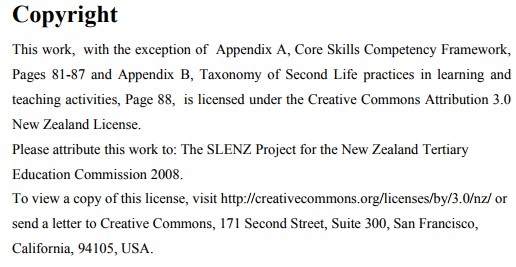
I then decided to investigate my own resources to find out more about the type of CC license issued. Firstly, I looked into the Second Life Education NZ (SLENZ) Project. I checked out the Literature Review and found the license information.
SLENZ Literature Review

SLENZ Lit Review Copyright statement
I also examined the Milestone Reports and found the same thing.
Milestone Report Copyright statement
I even checked our resources inside Second Life and found the hover script above the builds with the same – Creative Commons Attribution Share Alike 3.0. 
The license information hovers above the packaged build in SL

So, what does that mean? Thanks to my research I found out anyone can share (copy and redistribute the material in any medium or format), or adapt (remix, transform, or build upon the material for any purpose, even commercially). These rights are given as long as the person who makes use of the resource provides attribution (i.e. appropriate credit, a link to the license, and indicates if any changes have been made). I think this is as it should be! I discovered that all my online resources had the exact same Creative Commons Attribution Share Alike 3.0.

My research report on my Kitely literacy game, The Mythical World of Hīnātore, is available on the Ako Aotearoa website. Once again, Creative Commons Attribution Share Alike 3.0. I love being instrumental in sharing my research, my knowledge, and my abilities.

Ako Licensing statement

The Mythical World of Hīnātore


Copyright, the Public Domain and the Commons

A number of years ago, open education was a term I found  interesting but I did not see how I could apply it in my present position. Fast forward, now I am at a different place and have a different view. I see it as the path education must take for the good of society. My early perspective focused on what was in it for me? Why would I want to share my work? I never saw the big picture,  I did not take into account the student’s perspective or the perspective of others where the opportunity to learn is a struggle. I decided to enroll in the EdX course, Introduction to Open Education. My biggest take-away from week two was understanding the historical sense of open education.

Intellectual Property

If an individual created some tangible form, whether it is a doodle on a napkin or a few notes into a recorder, that individual had to protect their right to own that creation.   Historically,  the individual would have to register that creation for copyright protection. Why is protecting intellectual property important and what does it do? Copyright acknowledges the individual who originated the creation and by law gave jurisdiction of it’s use. It allowed the originator of the creative work an incentive of a limited period of time for commercialization.

Copyright


What has changed? In 2001,  an American non-profit organization called Creative Commons cc_large was formed committed to making available the creative works for others to build upon legally and to share. Several copy-right licenses known as creative commons licenses are free of charge to the public. These licenses allow creators to communicate which rights they reserve, and which rights they waive for other creators. It is important to understand Creative Commons licenses do not replace copyright, but they are built upon them. If there is no copyright then there can be no Creative Commons license.


Creative Commons Licenses Impact

These licenses make it easier for people to share their work. The licenses are now the mechanism to express in legal terms that the copyright holder (creator) hereby grants permission to the user to copy, distribute, edit, remix, and build upon their creative work.  As a result, these licenses make it easier to share and they lower costs associated with copyright responsibility and control, making it more profitable for the copyright owners and the individual seeking use of the work.

Public Domain

Works that are in the public domain are those works whose exclusive intellectual property rights have expired or were created before copyrights existed. Therefore, it is available for the public use. There are also works not covered by copyrights such as formulas or recipes.

Three Components of a Functioning Commons

  1. It works because copyright exists. It is built off copyright.
  2. The user must credit the creator of the work and keep the copyright notices or permissions intact on all copies of the work. They have to link to the license copy of the work.
  3. It relies on engagement to enforce the norms of the community.

Image Credits

Creative  Commons icon -AJC1 https://flic.kr/p/48fKeV


Filed under: Copyright, Creative Commons, OpenEdMOOC Tagged: Copyright, Creative Commons, Open Education