What research says on OERs?

Reflections on Week 5: #OpenEdMOOC

Based on discussions on week 5, I carried out a quick research by benefiting from text mining and social network analysis to see the patterns on OER research.
The research corpus consists of 499 scientific publications that are indexed in Scopus and have "OER" or "Open Educational Resources" in their title.
Based on 1039 keywords, I analyzed keywords with occurrences of a minimum 3, which ended up 96 keywords.
The initial findings indicated that OER is simply an issue of higher education, it is a practice of some expected approaches such as open education, open and distance learning, distance learning, e-learning and blended learning. Interestingly, F2F learning wasn't covered much in the research. Quality assurance is a topic to be explored, and culture seems to be one of the barriers (as discussed in earlier weeks). Among the 5Rs, "reuse" seems to be most preferred "R".
Now, I feel encouraged to explore more the research on OERs? I hope I will find someone to collaborate, I will create some time to explore more and then write on this topic ;)

Platform Design: Research Directions (Part 5 of 6)


This course has been a welcome primer on the essentials of OER: from the philosophical foundations of openness to the reasons for each of the five R’s to the provenance and application of Creative Commons.  We’ve had an introduction to and overview of an emerging field.  Of course, the domain of knowledge about OER runs much deeper than the overarching concepts we’ve been exposed to here, but revisiting them at a high level has been a healthy and helpful refresher of what many of us have seen emerge over the past ten years.

It was about ten years ago when I first had an idea for a platform for sharing.  Back then, building it would have been cutting edge.  Now, enthusiasm for yet another OER platform seems pretty tepid, maybe even worthy of a sigh.  So I’d like to ask this community for some advice.

To do so, I’d like to share some of my key takeaways and impressions from the course, and ask for counsel on appropriate next steps for a project.

~

Some context: while most people on this course seem to work in higher ed, I teach high school English, and when I began teaching 18 years ago I sought to gather the wisdom of my colleagues in a file cabinet in our department office.  (How quaint!)  After five years, I left teaching to become a musician in New York City.  It was excellent, but I missed the purpose-driven life of an educator, and so I returned to graduate school, and then back to teaching.  During this time, which also brought the advent of social networks and collaborative content management systems, I marveled (in disbelief) that no such network or platform had succeeded at creating a professional knowledge base for educators.  Certainly, this was not for want of trying.  Many efforts had and have since emerged, but none have succeeded at unifying the field.

When thinking about platforms, a few design principles occurred to me then, and, surprised at how infrequently they were adopted or experimented with, I set out about five years ago to test them.  It has been an experience of learning to build and design an organization, to collaborate and lead.  Not the same skills as being a high school teacher.

~

This course has validated some of the lessons learned during this time of building a small nonprofit and testing it with teachers.  Many mistakes were made.  Many are yet to be made, too, I’m sure.  Still, many successes have come also: implementation of the prototype for lesson study in a graduate school of education, validation by users in structured environments, and anecdotes that make a maker smile.

This course has also shed light on some essential truths that had been lurking underneath the surface of the work so far, but I hadn’t yet articulated.  Week by week, they unfolded like this:

Week one: I set out some of my hypotheses and first impressions in my first post: “Learning by Sharing: Why We Do, Sometimes Can’t, and Often Don’t”  The key idea in this post is that when building OER platforms, design matters.  What I don’t fully write there is that two key design principles that seemed central to me from the beginning of this work have been rarely implemented in the landscape: a topic-oriented architecture (like Wikipedia) and direct interaction with content (work isn’t trapped in documents, but engaged directly in the browser).  In my questions at the end of this post, I inquire about how to test more formally the significance of these observations and assumptions.

Week two: My post “The Commons: It’s the Community, Stupid” was about a key revelation: the commons isn’t really about the shared resource, the commons is really about our behavior in relation to the shared resource.  Building a repository or a platform won’t change education unless the repository or platform changes the way educators interact with it and each other.  OER are useful only insofar as we use them, and that’s what the community is about.

Week three and week four: both of these lessons and discussions helped reinforce how we can construct knowledge in a way that resolves the reusability paradox.  This challenge has been articulated for years in another way by Justin Reich: that “curriculum doesn’t compile.”  In education, practical knowledge grows like a tree, becoming customized to our classrooms, rarely converging, and so reusability requires revision and remixing.  Without seamless and easy revision and remixture, education resources will languish.

~

These statements can be articulated in three hypotheses:
  1. Finding content is easiest in a topic-oriented knowledge architecture. (Week one: design)
  2. Revising and remixing content easily requires direct (non-document-intermediated) interaction with content. (Weeks three and four: usability)
  3. Building community requires patterns of human interaction around content that are driven by fundamental professional or personal needs, matching intellectual demand and supply. (Week two: the commons)

~

Over the past four years, with the informal and formal help of many people and the generosity of four schools and two foundations, I’ve developed a prototype platform.  It’s a third generation prototype, growing incrementally towards a coherent vision.  The platform is still closed, because it’s not in a form that is ready for public consumption, but it has a few hundred users and feedback is positive.  We have not yet been systematic and rigorous in our testing—mostly because this work has always been in addition to a full time job (but that feels like an excuse)—but we have also not been shy about gathering lots of feedback, if not through scientific methodologies.

At this point, we’ve developed a topic-oriented architecture (hypothesis 1) and teachers access content directly (hypothesis 2).  But we haven’t yet activated tools for revising and remixing (hypothesis 2) because the chain of repercussions that will follow once peer revision is possible requires design elements not yet implemented.  Lastly, we’ve built the most basic community interaction tools (hypothesis 3), but not yet the planned ones that are essential for matching intellectual demand and supply.

Developing and implementing these final components of a working prototype are the focus of several grant applications currently in the works. (Grateful for references if you know people!)

~

Of course, like any responsible person, I’ve wondered if this has an element of tilting at windmills, of throwing resources at an intractable problem, chasing after some imaginary, inevitably-elusive vision of systemic change.  A well-respected researcher said in a call recently: lots of really smart people have spent hundreds of millions of dollars working on this—what makes you think your approach is any different?  (The same researcher also said that the expertise of those immersed in a subject sometimes gets in the way of seeing the benefits of novel solutions.)  So why persist?  In this case, it’s the overwhelmingly positive feedback from teachers--for whom this work is done--that has continued to propel this project.

And so, since budgets are limited and the scope and cost of the work is growing, the work has transitioned to a phase in which I/we aim to be more rigorous in research and more scientific in testing.  Since the OpenEdMOOC community (especially its professors) are as closely tied to this work as anyone, I have three questions that I’d be grateful for guidance on to ensure that this is a meaningful application of resources (not only money, but also years of my life and others’ too):

~


  • First, could someone offer guidance on what work has been done formally testing/researching knowledge architecture paradigms?  Since the 90s, the biggest paradigm battle was between Yahoo and Google, between trees and search.  Search won.  But Wikipedia models another information architecture paradigm.  And Reddit another.  These have thrived, if imperfectly.  What knowledge architectures have been tested in OER?  Of course, I’m particularly interested in: has a topic-oriented approach been tested?


  • Secondly and similarly, has there been much research on successfully scaling educator communities?  Edmodo created a user group for Language Arts teachers that has 550K members (though not all active).  Ask a question there and you’ll get an answer.  TeachersPayTeachers has created a supply of resources that covers virtually every content area.  Want something to teach? You can find it there, but you have to pay for it.  One is a successful community (if not a successful business).  The other is a successful content repository (if not an open community).  We’ll succeed when the twain meet.  Is there recent research on essential components for scaling communities?  My favorite so far is the US DOE’s Exploratory Research on Designing Online Communities, which offers questions, if not directions.


  • Lastly, do you have recommendations of models for rigorous user (teacher) testing?  To a researcher, this question is, of course, hopelessly vague—there are thousands of models for testing—but the question is meant to surface reports that offer replicable methodologies that are broad-reaching in their analysis of how teachers behave online when interacting with educational content or each other… and that are also understandable to someone who doesn’t know what a Q-methodology is.   My favorite example is from work done by the Smithsonian Institute in 2012 during their Digital Learning Resources Project.  Are you aware of other research that a (very) small team could emulate?


~

These are questions designed to help determine whether this work is a fruitful application of time and funds—and what next steps for this project make sense.  I’m grateful for your guidance.
Impacts of OER in Community College

I appreciate Stephen Downes take on OER – that there should be “no significant difference” between classes taught with OER or commercial text as far as outcomes go. I got into education to see that happen. The impact that I have measured in the past is grades, completion rates, and student satisfaction. I completely respect and value his definition of impact, and it would take a very deep longitudinal study to track that. In the community colleges I have worked at, we have had some more immediate problems to solve. There are five areas where OER and open textbooks are critical to the success of community college students: Cost Most of our students are working. Money is a huge issue. It should not be this way but it is. It is barbaric that the richest society on the planet can’t take care of health care or education, but that is where we are. The state of Washington has one of the highest homeless populations among its students. There are 40,000 homeless students in Washington. And a study came out that said that across the U.S., 14% of the college students are homeless. How are students supposed to learn, let alone have a transformative experience when they are worried about the next meal or where they are going to sleep? Eliminating the cost of textbooks is an essential step in solving this problem. Financial Aide  For various reasons, some that the students might be able to control and some they can’t, financial aide is often late. This means that students who are on financial aide are often two weeks behind in the reading. This just adds to the stress of being in college. Yes, we can put books on reserve in the library, but it is not the same experience as having access to a text when work schedules and transportation allows. Relevance and Corrections Students are often paying for books, resources, and at least chapters that are redundant with other classes that they will not use. Also, if there are errors in the books, we often have to wait two years, or what ever the publication cycle is, to get corrected texts. With OERs, faculty and students can customize the texts and make corrections instantly. Student-Authored OER Even better than making corrections, I have had the honor of working with a class where the students created the text. The assignments in the Communications class were designed to update the text and keep it relevant for the next class. The students had real ownership of the learning and often were available to help the next iteration of students work on the text (which was a wiki). Student Satisfaction Each semester, I would survey the students to have them talk about their experiences with the courses and learning materials. The open text book classes always had a greater student satisfaction because the students had immediate access to the materials (sometimes before they even enrolled in the course), the materials were always relevant, and they appreciated the lower cost. Often the research around OERs is performed at colleges where the students do not have the financial concerns, are highly motivated, and are not under the stress that community college students find themselves. I would find it very easy to believe that for students at MIT or Stanford, there would be no significant difference, but for students in the community colleges, it is all the difference in the world.

Connectivism and Open Education

Ramon Llull's Tree of Science from L'arbre de ciènciaVahid Masrour sent out a link to our Open Education MOOC this morning to Mark Weller’s “Openness and Education: a beginner’s guide” and it got me to thinking a lot about Connectivism. Connectivism is the learning theory founded and championed by George Siemens and Stephen Downes. There are a number of components of that theory that I think are important to the discussion of open education. I list some of Siemens’ principles of Connectivism below (my comments in italics):
  • Learning and knowledge rest in diversity of opinions. This should be the very spirit of openness – seeking the diversity of opinion – Alexander von Humboldt once wrote that “truth rests in a diversity of opinions.”
  • Learning is a process of connecting specialized nodes or information sources. This is something that we must do – learning is an activity – not a passive reception of information – or the mere existence of information. Possession of a textbook, OER or not does not mean I will learn from it. 
  • Learning may reside in non-human appliances.
  • Capacity to know more is more critical than what is currently known. This is particularly important as we face unprecedented information over-load, a crisis in information management, and a deficit of critical thinking. 
  • Nurturing and maintaining connections is needed to facilitate continual learning. Notice that again, this is something that the student does. It might be modeled by the instructor, but the principle demonstrates great faith in student agency. 
  • Ability to see connections between fields, ideas, and concepts is a core skill.
  • Currency (accurate, up-to-date knowledge) is the intent of all connectivist learning activities. I see connections here to the benefits of OER – with OER we are able to crowd-source the creation and updating of knowledge without having to wait for the two-year publication cycle for corrections to textbooks. 
I am one of those who come to open education through the humanities. I still see it through that lens. I don’t see it through the technology lens even though George Siemens once called it “a learning theory for the digital age.” I think it is that, but I think what makes it a viable theory and a useful tool is that it answers questions and solves problems that go far beyond the “digital age.” I think that the conversations we are having around Open Education are important. For myself, Connectivism is the pedagogy of Open Education – it has all the requirements for a theory that not only addresses how learning occurs, but it accurately describes what happens in an open learning environment (facilitation, student agency, creating teaching and learning community, etc.). I don’t agree (or maybe understand) every part of this theory. I never liked “learning may reside in non-human appliances” when the very definition of “learning” requires a person to do the learning, but never mind that for now. One of the things that Education Theory is really bad at is accounting for how people learned, taught, or organized information in the past. When read books about how people are supposed to learn, I always think back to Chaucer’s time and wonder how he became so educated in a day when pedagogues literally beat information into students. Despite the educational theories of the day, Chaucer managed to learn. I read some criticism somewhere of Connectivism once that made the ludicrous claim that unless Connectivism could account for every sphere of human life, it couldn’t account for any of it. This is a standard that no theory is subjected to – certainly not a scientific one. No scientific theory would be foolish enough to make that claim. Theories are informed by facts, hypotheses, and experiment – not by claims to have answered the secret to Life, the Universe, and Everything. As soon as you have a brilliant mind like Whitehead come out with the Principia Mathematica who proves once and for all that there is an ultimate system of math, you have an equally brilliant mind like Gödel come along in the next generation and prove that any “mathematical system” has to be either incomplete or inconsistent. And despite this, my High School still insisted that I learn the stuff. While working in the K-12 schools and studying Education for my masters degree, Constructivism was the main theory du jour. In a nut shell, Constructivism says that learning is socially constructed and that folks learn by applying past experience to new knowledge. I still have a lot of respect for it as it addressed many issues in education I was encountering at the time. It also helped shape early online learning experiences. But like most theories, there are some limitations. There are forms of learning and experience that learning theories can account for, but they usually fall short with the mechanisms or tools of learning. The invention of writing, universal literacy, and cheap paper were huge technical innovations that spread information and learning. Unfortunately, Stanford had not been invented yet so there was no one around to finally codify, once and for all, how learning took place in the human mind back then. There has to be a huge connection between the technologies of information and how we communicate as a species, but I have not found a learning theory that accounts for that. But that understanding, making those connections, is one of the things that the Humanities does really well. Lets take one tool or mechanism for learning; something as simple as concept maps. Concept maps were an important part of my work as a developmental education instructor and are important in my work as an adult basic education instructor today. My students use them as a way to start their drafts of papers, to make connections between ideas and situations we are studying (history of Afghanistan, for instance), and I also use them as a way for students to build presentations. The concept map was also extensively used in the course “Connectivism, and Connective Knowledge” taught by George Siemens and Stephen Downes. They were used there to demonstrate knowledge of connectivism as both a formative and summative assessment. So are concept maps new? Are they “the digital age”? Of course not, artistic representations of branching and connected information are a human archetype – it is hard-wired into how we think. I used to give a presentation on concept maps that would annoy the hell out of traditional education researchers because the only evidence I gave was artistic evidence and proximity data (if two things or words are close together in context, they must share a similar meaning). The presentation began with a series of images to give the workshop participants the sense of the breadth and scope of the use of the image of the visual branching of information. The point of the presentation is that through all time and across all cultures, there has been some kind of external, connected expression of what we know. Manuel Lima in his “The Book of Trees” does a great job of expressing this. My point with all of this is that Connectivism is a viable learning theory because it addresses not only the Digital Age but the past as well. I think it fits in with the spirit and goals of Open Education and should be looked at seriously by any one interested in Open Education.

Research on OER Impact and Effectiveness

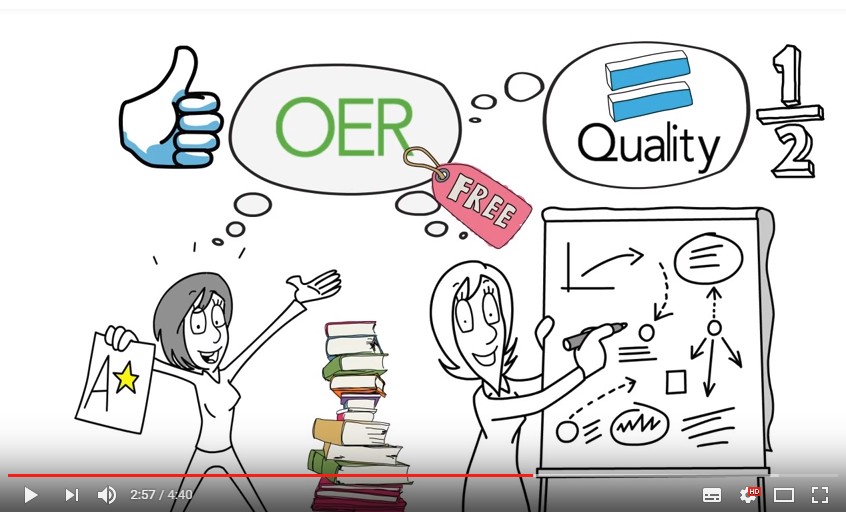
Most of the readings set for Week Five dealt with research into the use of OERs. A review was covered in a research shorts video from YouTube entitled A Review of the Effectiveness & Perceptions of Open Educational Resources as Compared to Textbooks(based on Hilton, J. (2016). Open educational resources and college textbook choices: A review of research on efficacy and perceptions. Educational Technology Research and Development, 64(4), 573-590)This review examined 16 empirical studies of courses where OERs had replaced traditional textbooks. The research studies focussed on either the learning objectives and success rates or on the perceptions of students and lecturers regarding OERs. Only one out of the 16 studies found a lower success rate for some students using OERs. The general consensus was that OER use was effective with higher test results and lower rates of failure and/or drop-out. It is noted that researchers appreciated the limitations of their studies and did not attribute direct causality in their conclusions.
Review of Hilton, 2016
 
The video narrative contained an instance of inaccurate reporting when it stated, “A sizable majority felt that OER were of better quality than traditional textbooks. About half said that they were of similar quality. And only a few thought that OER were inferior”. If you read the original report by Hilton (2016) the statistics are: 33% viewed OER positively, 50% saw OERs and traditional textbooks as of a similar quality, and 17% viewed OERs as inferior. There is no way you can call 33% “a sizable majority”, when a majority implies that it is over half! Still, the results do indicate that both lecturers and students were positive in their perceptions of OER: students valuing the “free” part of OERs, and lecturers appreciating the high quality and flexibility of OERs. My favourite question from Hilton (2016) has to be: “If the average college student spends approximately $1,000 per year on textbooks and yet performs scholastically no better than the student who utilizes free OER, what exactly is being purchased with that $1,000?” This is a question well worth considering.
What is being purchased with that $1,000?
 
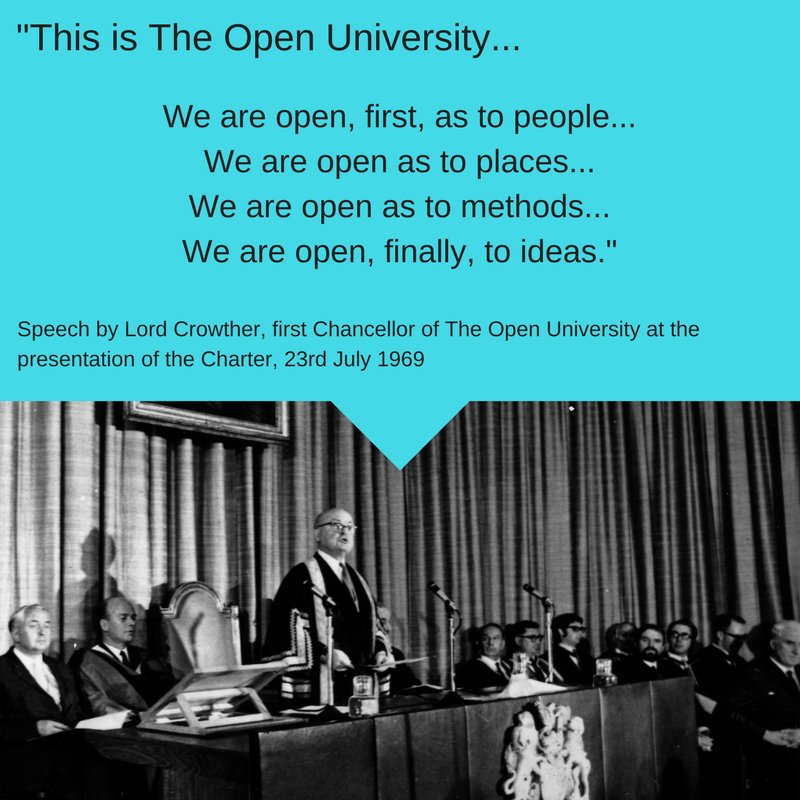
Weller (2012) in a discussion of The openness-creativity cycle in education described the open scholar and the relationship between OERs and creativity. This article comes from the Open University (OU) in the UK. The mission statement from the OU is 'Open to people, places, methods and ideas'. The OU has long been renowned for its open access policies and has been the source of a lot of research into open access.
OU, 1969
 
Weller (2012) defined a number of related aspects of open education, but the one that was most meaningful to me was the open scholar. The open scholar combines the creation of digital artefacts with a socially oriented distribution network. The open scholar, in my opinion, represents the core of learning in terms of a connectivist pedagogy. I see myself as an open scholar. According to Weller (2012), the open scholar creates, uses, and contributes open content, self-archives, applies his/her own open research, shares, supports open learning initiatives, comments on others, publishes in open access journals, and builds networks. This is the direction in which I have been moving for almost a decade.
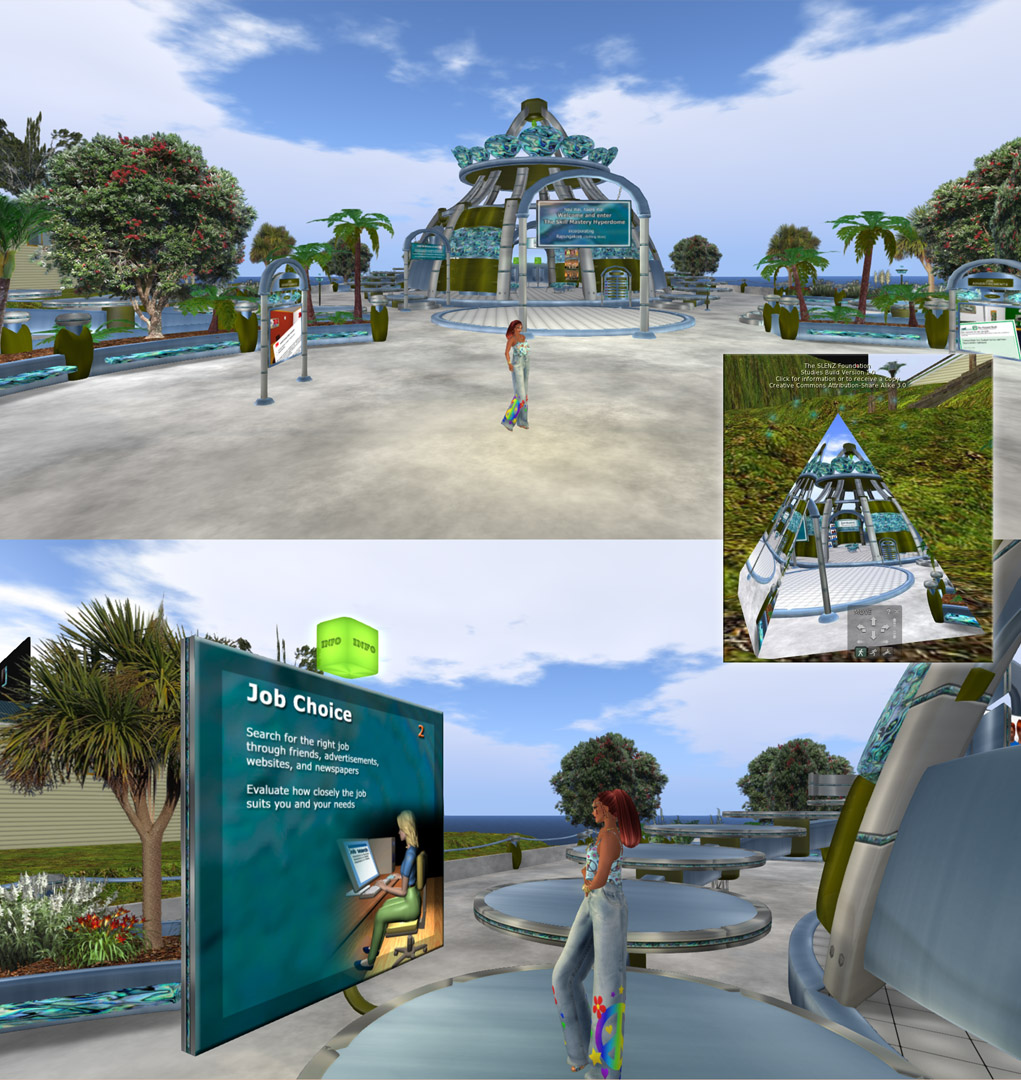
Lead educator of SLENZ - my workshop participants
 
Creativity is high in the list of characteristics of the open scholar. I consider the work I have done creative. I have open research data available on both virtual world projects in which I have taken a lead role. I was lead educator for the foundation build, part of the Second Life Education New Zealand (SLENZ) project. The initial results of this data are available at:Second Life Education in New Zealand: Evaluation Research Final ReportThe initial research for my literacy game, The Mythical World of Hīnātore, is available here:Literacy game in a virtual worldHere are a few pictures of both builds. I have had very positive perceptions from both students and lecturers who have participated in my research. However, the research was not focussed on the aspect of openness but on either the gaming or simulation aspects of the builds. It would be interesting to look further into the impact both builds have made due to the fact they were both created using NZ 3.0 CC licensing. 
Koru SLENZ Foundation build
Literacy game, The Mythical World of Hīnātore
 
Having taught in an open entry foundation course for nearly a decade, I have always been interested in research into open entry, open access programmes. Dr Barry Hodges from the University of Newcastle in Australia reviewed research into open entry/open access courses (reported in a review I wrote (2017) in Mana Rangahau Issue 1). He concluded that the research evidence indicated that open entry/open access courses suffered from the challenge of four deficits: the challenge of achievement with high drop-out and low success rates; the challenge of academic standards, i.e. accepting failure or lowering standards; the challenge of student support – ““Opportunity without support is not access”; and, the challenge of multiple discourses, acknowledging students who are proficient in discourses other than the dominant. He suggested rejecting the deficit model and creating a dynamic university culture embodying a multiplicity of sub-cultures, each imbued with their own discourses, literacies, and processes.
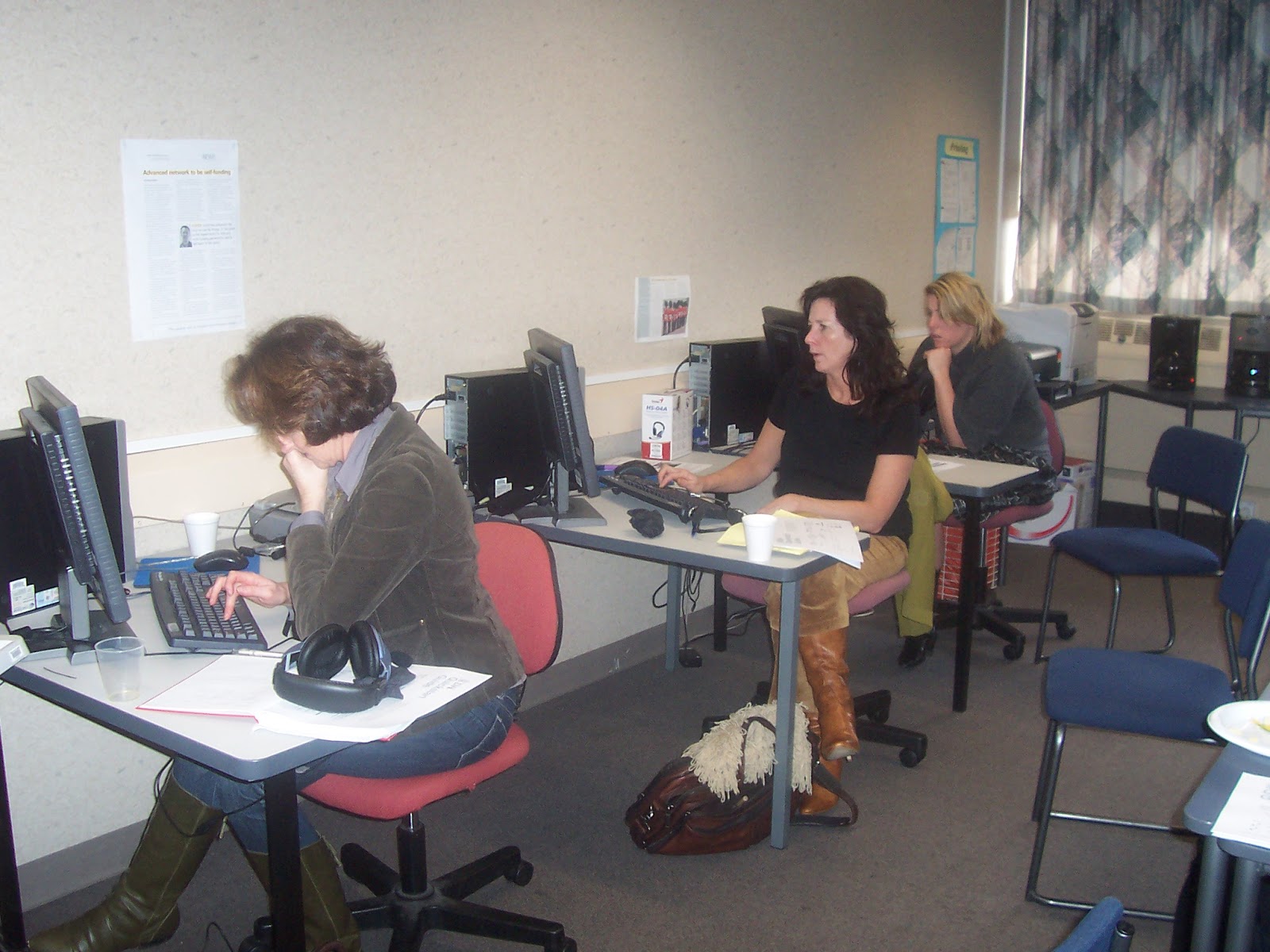
Me surrounded by my wonderful students
 
The narrative approach to research must be as important as collecting a mass of statistics. It is incredibly difficult to indicate the effectiveness of an approach to education in terms of causality. There are so many factors that impact on our students and their learning. Switching to an OER may seem to make a positive difference to a group of students. But, it could also be attributed to the motivation of increased digital material and less reliance on the printed page. A number of my own students have conducted research into the use of little OERs (as opposed to big OERs – see Weller, 2012). Some have incorporated OER puzzles, games, and video content into their courses and found the students most receptive to the changes. However, perhaps the positive results obtained could be attributable to their own increased motivation and passion and how these characteristics have been passed on to the students. It is easier to identify causality when examining individual stories and how changes have impacted in particular cases.An interesting opportunity for research has been created by the new government in New Zealand, a result of the election held last month. Our new Prime Minster, Labour leader Jacinda Ardern, has promised that all new tertiary students will receive their first year of tertiary study for free (see the video link below).
Jacinda Ardern, NZ PM (for video link, click the photo)
 
I imagine a priority for the new Labour Government will be to prove, through research, the benefits of instituting this policy at a national level. However, I tend to be sceptical of politically inspired research and believe that individual institutions should look at the effects in terms of their own students.Stephen Downes, in his video, Research on OER Impact and Effectiveness, made a couple of very important points. He questioned the actual meaning of research and the meaning of impact. Stephen recommends that the information that is needed yet not done, is research into how open resources help society. Yes! OEEs should have a long-term impact on a person’s sense of personal worth and their value to society. In Stephen’s own words: “I see research on grades and graduation rates and course completions and crap like that. And I'm not interested in that. I'm interested in how open resources help society”. I am currently working on my PhD in education, examining the effectiveness of my own literacy game. I have already conducted extensive research using numbers and quantitative data. This has all indicated a positive perception of the game and how it has improved sentence structure and grammar in student’s formal writing. Now, I am looking at narrative, and how the game has personally impacted on select subjects, both short and long-term. The results I have obtained are interesting in that the qualitative data supports the quantitative data. My game may not be a very apt example of seeing something change society but I have seen a game change a mother-son relationship, a son’s progress at school, and a student’s decision-making processes in areas unrelated to the original written literacy in the game. 
Comments on the literacy game - looking back


OERs… It’s Complex (#OpenEdMOOC)

To continue a discussion from last month’s Transparent Educative Experiences (#OpenEdMOOC), I wanted to tease out a few more ideas related to OERs and how OERs and pedagogy differ from a more systematic approach needed when researching OERs in practice.  As important as open and educational are in determining how an OER is defined, I find the two terms tend to be too nebulous when it comes to the obligation of narrowing down a researchable topic to something that is S.M.A.R.T.: specific, measurable, attainable, relevant, and timely.

OERs and Pedagogy

The vagueness of OERs is necessary when it comes to employing pedagogy within a formal educational context.  “It seems clear… that there ought not to be an a priori stipulation that something may or may not be an educational resource” (Downes, 2007, p. 31). Yet instructors continually consider different resources by anticipating how they might lead to certain student engagement patterns and/or learning outcomes.  They probably also look for inverse relationships that take certain learning scenarios that might dictate how resources emerge from the educative experience itself. Instructors then predict what could happen, then report certain results if they decide the share the resource with others, say as an OER.  The next instructor to use the OER (whether a process, artifact, etc.) will take this reporting (a stipulation or condition, context, situation, etc.) and adapt and/or adopt it as necessary as the process continues.  So, when teacher practitioners are actively using resources to promote engagement and particular learning outcomes, how necessary is it to create a taxonomy of OERs (e.g., types of resources and resource media)?  Pragmatically, resources either promote or hinder the educative experience… it either works or it doesn’t.  Creating a taxonomy and trying to reach a consensus about what is open or not, educational or not, or what a resource is or not, places too much emphasis on the resource (material or one particular individual) and less about the collective experience that involves the complete network of social relationships, materials, and ideas/concepts.  Thus, the act of stipulating comes from understanding context, as in where the OER came from and how it might serve a particular purpose locally.  A “negotiation” exists between one instructor stipulating how a given resource is “educational” from experience and another instructor stimulating by predicting how this same resource might serve a purpose going forward.  

Research

When it comes to embodying OERs through research, terms like open, educational, and resource cannot remain vague.  The challenge is to follow a process of planning a research project that ends up being specific, measurable, attainable, relevant, and timely. To this end, Booth, Colomb, and Williams (2008) would consider the following:
  • From topics to questions
  • From questions to problems
  • From problems to sources
  • Engaging sources

Reflection

My concern with researching OERs is that the vagueness of OERs and pedagogy fail to reconcile with the systematic approach required to researching OERs in practice.  Also, I feel too much focus adheres to a singular relationship between an OER and its impact, instead of a more complex stance that views OERs as an emergent cause and effect from a particular experience or set of experiences.  For these reasons, I think the only way to approach OER research is through complex-related theories: complexity theory, complex adaptive systems, complex networks, etc. Image Attribution

What counts as effectiveness?

Week 5 of #OpenEdMOOC is about “Research on OER Impact and Effectiveness”. Certainly, OER adoption would somewhat increase if this research could prove that OERs do function equally well as commercial textbooks. To prove this, the research would have to copy the goals and measures from the traditional expectations that people have. I think there is a danger, then, that such expectations focus too much on how easily stuff can be ingested — a Nuremberg Funnel would be the ideal exchange value for the many dollars of a commercial textbook, wouldn’t it? But such a measure of effectiveness would be questionable. In my own discipline, math, we have the saying: “A king’s road to mathematics does not exist.” There are, instead, two completely different goals. One is to learn how to apply the rules for the necessary calculations that you may have to carry out in later life. The other one is to learn mathematical thinking. If you focus on making the former as easy as possible (which is a legitimate goal), it is less probable that mathematical thinking emerges. For example, if you always have perfect pictures, visualisations and simulations in your textbook media, you will memorize the concepts and procedures quicker, but you won’t develop the ability to visualize difficult relationships on your own, i.e., if the abstract is made less abstract for you, you won’t learn from it how to cope with new abstract things. To repeat an older metaphor: If we compare learning to carrying a load upstairs to the attic storage, there are two distinct goals. One is that the load should be stored up there, and the other is to work out one’s muscles. If it is only necessary that the stuff is accumulated up there in our brain, a ‘lift’ would be a welcome optimization.

Picture: ‘Attic storage’ by Flickr user adriane_l CC-BY

So, if measuring the ‘effectiveness’ is mainly about knowledge content and about storing it safely away (in a compressed way, i.e. in isolated chunks that are typical for ‘left-brained’ thinking), it will be very unbalanced. Measuring OERs, by contrast, offers the opportunity to try out and define new criteria. An obvious new affordance is that you practice your mental ‘muscles‘ more if you have to find your stuff on the web, by navigating and traversing the very connections that ‘are’ the knowledge. But there is much more to research of distributed learning, and much of what I wrote 9 years ago in week 12 of CCK08, does still apply. Filed under: OpenEdMOOC

Thoughts on Open Pedagogy v. OER-Enabled Pedagogy

I think I understand David Wiley’s frustration with the semantics around “Open Education” – it is a very broad term. “Open” means many things to many people as does “education.” I am not sure if “OER-enabled Pedagogy” really addresses the issue. It sounds too much like content is what guides the teaching and learning. What is the opposite of OER-enabled Pedagogy? Copyright-enabled Pedagogy? Copyright-disabled Pedagogy? Commercially-enabled? I understand what Open Pedagogy is – I know mostly because I suffered for 16 years under its opposite. Education is closed in the sense that it is expensive, classist, inaccessible, and strangled by corporations who define the curriculum with their “great” but expensive textbooks (or technologies). The closed classroom is hierarchical and led by an “expert” whose job is to transmit information to the empty vessels. There are social justice issues here, but that does not muddy the definition any more than the closure in traditional education muddies the definition of “traditional education.” I am teaching a course right now that uses some materials from an open textbook but most of the materials are links to newspapers and journals. We are not interested, as a class, in textbooks per se because we are looking at social studies from what is happening in the world today at this moment. We are looking at the Trump policy in Afghanistan right now. The course is student-driven, networked, and dependent on student sharing (blogs and presentations). In my practice as a teacher, this is an open class, an open pedagogy – it is not particularly dependent on the 5 R’s to succeed as a class, but it is open. The students learn a way of using information, communicating, and building learning networks. One of the things I do with the students is getting them away from the idea of debate: that only leaves us with right and wrong, winners and losers. It shuts down the discussion. We are working on deliberation: we survey ourselves on our values as individuals and as a group and try to evaluate the issues from a shared values/different values perspective. I think that “OER-enabled Pedagogy” is not “wrong” but it represents a different set of values than “Open Pedagogy.” Wittgenstein used to say that philosophy is not a theory but an activity, and like David, I am interested in what OER enables us to do but I am not sure it is time to stop the defining process.