Exploring my YouTube Copyright #OpenEdMOOC

In week 2 of a course I am navigating at my own procrastinator’s pace we have been asked to consider Copyright, the Public Domain and the Commons. I am actually really excited to delve into this week’s content because it is a critical think to understand as a content creator. Lawyers, Librarians and Educators please jump in and comment on this post to help me get my head around this issue.

Copyright

I live in Canada. Since the MOOC I am taking says that laws are specific to where you live I decided to visit the Government of Canada’s guide to copyright. If I am interpreting it correctly the Copyright Act “protects” materials that I produce (written work, sound recordings, videos etc.) since I am a Canadian citizen for 50 years after I die. Interestingly, “copyright exists automatically when an original work or other subject-matter is created, provided the conditions set out in the Copyright Act have been met.” These conditions, from what I can tell, are tat the work is original and produced in Canada (or another treaty country). There is an optional registration process explained on that page for those who are interested. From what I can tell Canadian law is a lot like what is explained in the video below. As our course instructors point out, copyright in an educational context is complicated. Much of the discussion over intellectual property and copyright is yet to be settled in the current discussions between faculty and their employers. Individual institutions may also have policies on intellectual property. That may be a topic deserving of further exploration in the upcoming months. Educators need to be careful not to share content that they do not actually own. To complicate things further, “Fair use” in Canada is a topic that is actually going through some clarification in the courts, but as I understand it that does not apply to public dissemination, a core component of open education. My librarian would have a lot to say about that topic. Recently, York University lost a legal battle over this issue (Read more here). Personally, I have avoided any potential “fair use” in my classroom because I am fuzzy on the boundaries of such laws. If you want to show a movie in class, play music or even post sections of a book make sure you run that by your local librarian expert before you get you and your institution sued. Or, better yet, move towards open educational resources so you don’t need to worry about getting sued. Copyright by Default  Copyright is assigned by default to creative works. Instead of opting-in to copyright, creators who want to share openly need to opt out. Take a look at what I just found hidden under the advanced options on my YouTube channel.
YouTube Copyright

YouTube Copyright

By default my videos are licensed under a Standard YouTube License. I didn’t read through all of section 6, but I did notice that “you retain all of your ownership rights in your Content.” Now I know why I get emails asking if educators can use my videos in their courses. I always say yes, of course, it is on YouTube, that means it can be used right … maybe. I thought that was a given when I posted videos online, but I guess the default is not that way. I am still a little fuzzy on this point since it is quite common for educators to give students links to YouTube videos to watch before/after/during classes. Maybe embedding a video in the course is different.

Gellinger / Pixabay

I want my videos to be used for education. What I need to wrap my head around is the consequences of moving to a creative commons license instead of the default license. Will I be misinterpreted when people remove the context in a remix of my video (one of the fears expressed by a colleague)? What about plagiarism? I have actually found one of my videos, unchanged, uploaded to a different channel without attribution in the past. Despite my commitment to openness, that kind of bothered me.  

Creative Commons 

Here is a helpful video explaining Creative Commons licensing. Creative Commons makes it easy for creators to grant permissions to others to share and use content they create.   Reach more people. That is a huge benefit of creative commons licensing. Generally speaking, I would like my videos and other creative works to be revised, remixed, reused and redistributed like Wiley and Green (2012) discuss. However, a lot of work goes into the creation of YouTube videos. As a creator I want to be credited (cited) for that work. There are a lot of creative commons licensing options. It gets a little confusing. YouTube has simplified things for my by offering me only two options – Standard or Creative Commons. The Creative Commons license that YouTube allows creators to select is a CC BY license (read more here). Conveniently, I think that is the one I want. Today I learned that it layers on top of Copyright and allows a creator to say what others can do with their work. If someone uses a video but doesn’t meet the terms set by the creator they can no longer use the work. Neat. I am just not clear on how that will be enforced on YouTube. I am fine with a remix of my videos – I just want to be cited. I also don’t want a pure copycat. Can I still make a copyright claim against someone who downloads a video of mine, doesn’t edit it at all, and re-uploads it without citing me? Creative Commons goes both ways.  Guess what – I have also discovered the potential to use other videos in my work. YAY! Now that I know about this feature of YouTube I might be able to cut down some of my own video production costs. I pay yearly for a lot of the images you see in my videos. The only problem is that I don’t like the YouTube video editor. This nifty website helps you find content licensed under creative commons licensing that I can download, edit and use! Awesome … I am going to add that to my to-try list. https://search.creativecommons.org/   Experimentation time I am working on a video about Open Educational Resources – it would only make sense to license that video using creative commons and test out this new approach.

Why you should Embrace Openness as a Value #OpenEdMOOC

I first heard of the open education movement during a life changing experience that ran in August called Ontario Extend. Since then I have dove into the movement head first by engaging with peers on Twitter, exploring opportunities through eCampusOntario, adopting (and reviewing) an open textbook, and taking a course called Introduction to Open Education through edX. This journey has been exciting and challenging as you may be able to tell if you follow my blog. Please join my connected community as I delve deeper into the open education movement, exploring the evidence around it.

What is Open Education

Good question – the definition of “open education” or “open educational resources” will vary based on who you talk to.  There is no standard definition in the literature (Wiley, Bliss, & McEwen, 2014) that I have come across to date. In a future post I hope to explore this concept in more depth, but for now let’s consider open educational resources as characterized by
  • Free high quality learning materials
  • Visible and accessible to the public
  • Can be used for teaching and learning

Why Embrace Open Education

There are so many reasons to embrace openness in education. Some of the ones that stood out for me include removing barriers to learning, therefore increasing access to education and creating new ways of engaging with learners around the world. One of my favorite take-aways so far in this OpenEdMOOC course is that No longer do I need to sit in front of a computer being my own critic. With a simple press of the “publish” button inside word press I can invite discussion around evolving ideas in my head that will ultimately increase my reflection and promote a higher quality end product. [Side note: Yet, in academia these open resources are traditionally not regarded as acceptable sources of information (a topic for another post someday)].   Openness should be widely accepted in education, in my opinion. After all, education is about sharing knowledge … If you are an educator you have probably dealt with students who have not been able to afford text books. Think about the difference it would make for them if you could remove that barrier to education – good news! you can. More an more high quality open textbooks are being published. There are not nearly enough yet, but it is a work in progress.   With an open approach to education you can literally break down the walls of the classroom and create more meaningful learning opportunities for students. Students can interact with people from all over the world and get answers to their questions. Openness is also beneficial for educators. Being open invites critique on a public platform where ideas can be shared and developed. It has made me stronger as an educator.

My Commitment to Open Education

If one perceives openness as a value (Wiley, 2016) then I have been committed to the idea of open education since before I became an educator. As a student I remember making my study notes “open” in a way by sharing them with my peers. If I had a website back then I would have posted everything I had. Sharing knowledge is just part of who I am as an educator. The idea is that sharing in study groups or with everyone would ultimately make us all more successful as nurses. Flash forward a few years and I became an educator who freely shares whatever I can wherever I can. The values underpinning open education resonate with my own values. It feels like I have found a home among friends who share common beliefs as I get more and more connected to open educators. While exciting this new journey I am on comes with scrutiny from those who fear their jobs will be replaced by open educational resources. The videos from week 1 briefly touched on this fear, dismissing it, but I hope there will be more discussion in the future.

Fotomek / Pixabay

I am particularly interested in Week 2’s content about Copyright, the Public Domain and the Commons.

NDE / Pixabay


References

Wiley, D. (2016). Iterating toward openness. Retrieved from https://opencontent.org/blog/archives/4828 Wiley D., Bliss T. J., & McEwen M. (2014) Open educational resources: A review of the literature. In: Spector J., Merrill M., Elen J., Bishop M. (eds) Handbook of Research on Educational Communications and Technology. Springer, New York, NY.

Resolving the Reusability Paradox (Part 4 of 6)


Being reminded of the Reusability Paradox (something I had been introduced to a handful of years ago, but had no context for deeply understanding then) might have been one of the most critical components of this course to date for me.  


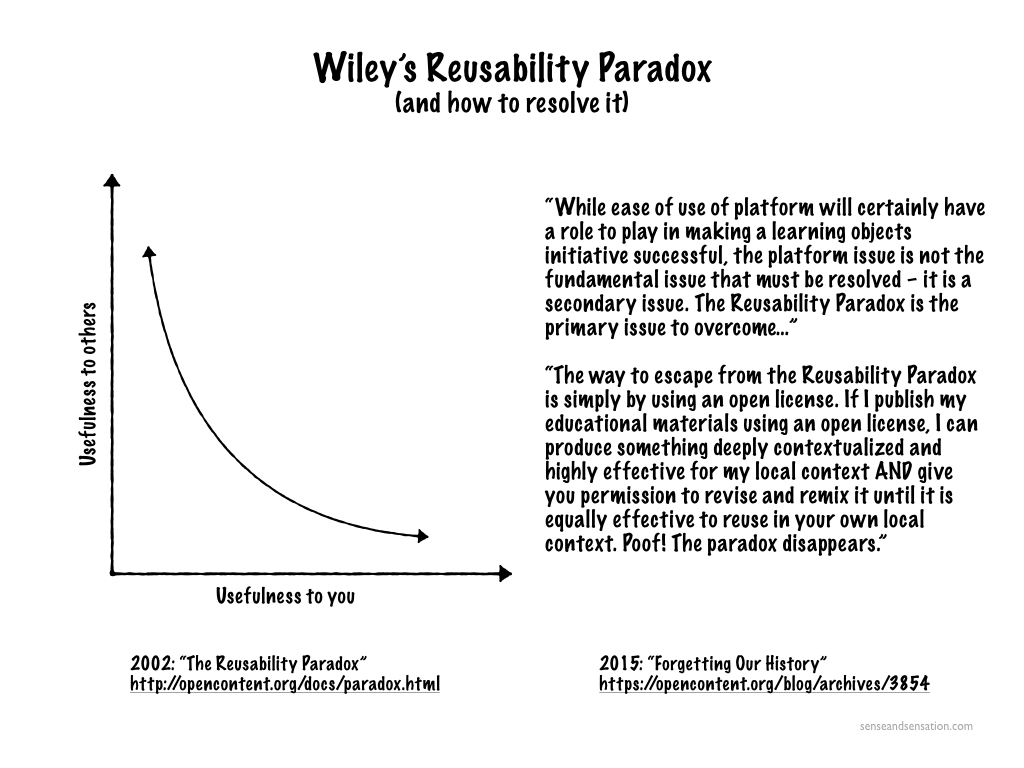
In brief (and in my own words), the Reusability Paradox states that the more useful something is in a given moment in a given classroom, the less useful it is in other moments in other classrooms.  The more a question serves a particular purpose for you, the less it will be useful for others.  Conversely, the more generally useful something is for everyone, the less useful it is at any given moment.  But once you customize it to make it useful in a given moment, the less useful it is to others.


The example of this in my mind has been the discourse surrounding growth mindset.  Everyone is excited about growth mindsets.  But how is that useful for a math teacher who is teaching how to factor polynomials?  In order to make it useful in that context, the math teacher says to a struggling student, "let's try completing the square" or "have we tried all strategies for factoring?" Because these encourage different strategies, questions or activities help a math student believe that their intelligence isn't fixed, and that they can improve at math by learning and trying different strategies for factoring polynomials.


But now that the particular learning approach/object/experience has been customized to be relevant to math teachers only.  Once customized with the language of a discipline the intervention is no longer useful to English teachers, history teachers, language teachers, etc.  This is the Reusability Paradox.  The more useful something is to you, the less useful it is to someone else.


~

This paradox had been lodged in my mind as something unresolved, and even in my notes from this week’s lecture, I included Wiley’s follow up statement—“The permissions granted by open licenses are the escape hatch from the reusability paradox.”—almost as an afterthought.  In the context of this week, the Reusability Paradox arose in discussion briefly, was lightly brushed aside, and then the lecture moved on.  The paradox was an accepted fate, and something of a non-issue.

But revisiting notes from old conversations and rooting around in recent blog posts by Audrey Watters (9/2017) and David Wiley (4/2015) led me to the realization that there has been contentious, exasperating, protracted discussion about "learning objects" (usable, portable bits of curriculum) in the context of the Reusability Paradox.  


And, it also led me to the rediscovery that the paradox has a solution, and that Wiley's offhand remark about an "escape hatch" is actually quite significant.

So, I created a simple image—graph and text—as a reminder that the learning object isn’t doomed, but that if it is to be (re)incarnated, it must be done so in a way that is remixable, fully. If we are to share bits of curriculum, we need to be sure that they are customizable, that they are fully open.  Without this capability, their usefulness to others is limited.  This is crucial.


I wonder if I should be confident in this conclusion, that I can take it as fact, or whether, as Watters cautions, I should dive more deeply to better understand the history of the debate.  We have time to only know so much...


~

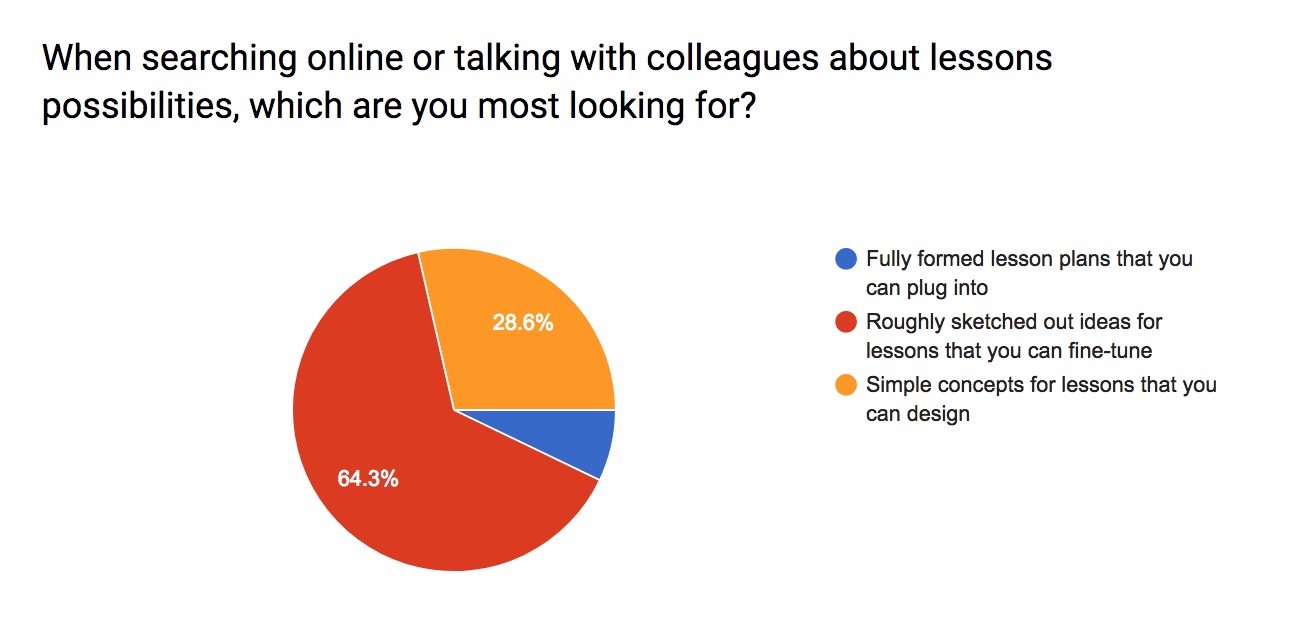
Upon reflection, I've seen this borne out in my own work on a local sharing platform.  We administered a survey to participants in a summer fellowship built around sharing resources.  What did they say they were looking for online?


It was clear that our teachers wanted flexibility.  They didn't want fixed objects.  Reusability comes from being able to tweak other people's practices.  They wanted ideas that they can fine tune, or conceptual frames that they can then design within. 

And this validates Wiley's "escape hatch."  The Reusability Paradox isn't a paradox at all if what matters most is a teacher's ability to edit, revise, tweak, or remix what other teachers have done.  The ability to change is all.  To adapt.  Teachers want to customize for their own settings.  They want to design it anew.

It's no wonder.  Teaching is the most creative profession I can think of.  We are designing experiences every single day, and delivering/performing them (even when we are the guide on the side) every single day.  The thrill is as much in preparation and delivery--in the design and execution--as it is in the relationships we form, the learning we structure, and outcomes we foster.

Learner Activity Hub Guide for #OpenEdMOOC and #YogaMOOC

For those that are taking The Science and Practice of Yoga (YogaMOOC) or Introduction to Open Education (OpenEdMOOC), you might have noticed that we have a learner activity hub for both (OpenEdMOOC here and YogaMOOC here). We did this so that learners could create their reflections on their own websites, but still be connected in manner that is better than posting links in the discussion forum.

After putting many people in the hub, I realized it would have been a good idea to create a more comprehensive guide to creating a blog for these hubs. Better late than never. If you have created a blog and got the email that you were successfully added, this guide might still help you improve your blog. If you got an email saying there is a problem, this guide will hopefully help trouble shoot what caused that. If you are thinking of submitting a blog, please read this guide fully before doing so (even if you are an experienced blogger – not all blog platforms work the same in the hub).

I will start off by going over setting up a blog for the hub, and then cover the parts of the form to sign up for the hub (OpenEdMOOC here and YogaMOOC here) and why we need that info. First, the most important part.

You Need to Have a Blog

A blog is optional in either course, therefore you will have to set one up on your own (or use an existing one). We do not create a blog for you (some people filled out the form thinking that was the case). The blog you use will need to be public (private blogs do not work with the hub). Putting your blog in the hub is also optional, so no problem if you want to keep it private.

WordPress.com blogs are the best option to use with the hub, so if you are new to blogging (or want to create another blog just for this course), then I recommend starting there. The Hub uses WordPress itself, so it works best with those blogs that also use WordPress. Blogger/Blogspot blogs also work well (just read the exception to tags/categories below). Other blogging platforms – Tumblr, Weebly, Wix, Web.com, etc – are hit and miss. The Hub uses a technology called RSS to pull in posts, and some of those platforms have RSS feeds turned off it seems. If you use those platforms, you will have to turn on RSS. If you want to use one of those platforms with tags/categories (see below), you will also need to turn on RSS for tags/categories.

Setting up a Blog

Once you create your blog, you will need to set it up so that we can pull in your posts to the Hub. A newly created blog will generally need a few things to be ready for the hub. Since I am recommending WordPress, I will cover how to this on WordPress – but other blogging platforms should have similar functions.

First, you need to decide if the blog is going to only be used only for the course, or if it will have other topics covered (or already has). Either way is fine – if you want to cover a wide range of topics, but only want to have the ones on your course feed into the Learner Hub, we can do that with tags and categories.

Once you have decided how to use the blog, come up with a title for it that matches how you want to use it. Then change the title in the General Settings. We have probably 30 or so blogs currently in the Hub just called “Site Title” because many don’t change this setting :)

Next, you will probably want to edit the About page that most blogs come with. It is a good idea to put a picture you want to use in the Hub on that page. You have probably noticed that the Hub shows pictures of some people with their post, and generic ones for others. This is because I was able to find images of some people on their websites. I start with the About page and use any image there. Then I look on the sidebar or any other places for images. I also look on Twitter for an avatar there if you put that in there. I then look for any other images on the blog, even if they are stock images from the default template. If I can’t find anything, or the only image I can find has already been used, then I put your name in jdenticon. Note that you can use any image of yourself you want, or even something else to represent yourself like your favorite animal. Just note in the comment forms where the image is that you want me to use, or respond to the confirmation email from me with the image or link to it. Whatever you are comfortable with – your picture or some other image – is fine with me.

Finally, you need to have at least one blog post about the course you are taking, even if the whole blog is going to be used for the course. People try to spam the hub with their… whatever, so having content on your website about the course let’s me know you are legit. WordPress blogs start off with a sample blog post already there. The Hub seems to ignore these if they are left as is, so make sure to change that post to something about the course, or delete it and write a new one. If you want to use tags or categories to designate which content to pull into the Hub, then make sure to add a “YogaMOOC” tag or category to your post (these are called “labels” in Blogger). This is probably the biggest mistake people make filling out the form – they say they are using a tag or category, but then I can’t find a post with either one. I respect people’s wishes on this, so make sure to do what you indicated in the form. If you need help on tags/categories/labels, see these links:

Final note – if you don’t like the way your blog looks, there are thousands of different themes you can choose from to change it.

Filling Out The Form

Once your blog is ready to go, it is time to fill out the form for your course. I wanted to make a couple of notes about the fields on the form:

Name / Pseudonym: We use this to sort the posts in the Hub. Each person is given a category based on their name or a pseudonym. Please note: if you put just your first name in here, there is a chance that will get taken up quickly, and I will have to improvise a longer name for you. Names like “Kat”, “John”, etc get taken up quickly.

Email: This is where we will send confirmation or notification of failure. These are bulk emails, so be sure to check your spam folder.

Twitter Name: Not a requirement, but if you have an avatar there you would like to use in the Hub, then fill this out.

Blog URL: This is the second place people often make a mistake. This is the link to your blog for the people that read it, not to the control panel for your blog. Make sure to view your blog and share that full URL. Also remember: if you can’t copy what you put into this field and put it in a browser to pull up your website, then neither can I. Please make sure it is a full web address. Also, make sure it is not a link to your Facebook page or Instagram account – these are not blogs.

Hub Options: Make sure to choose the one that you will use (full blog dedicated to course, using blog category for course, or using blog tag for course). This is where I find the most mistakes in the form – people say they will use a tag or category and then do not. Also, make sure to use the tag/category designated for your course (YogaMOOC or OpenEdMOOC). Please note that using hashtags like #YogaMOOC or #OpenEdMOOC in the title or body of a blog is not the same as using the label or category feature of your blog.

Comments or Concerns: Let us know any comments/concerns you have here. Also, if there is a specific image you want to use in the Hub, let us know where it is in this field.

You will only need to submit the form once. The process of getting your blog into the hub is a manual one, so there could be a delay before I get it finished (especially if you submit outside of business hours in my timezone). If your blog makes it in the Hub, I will send a confirmation email. If there is problem, you will get an email about that (a generic one that repeats some of this blog post). Once you have fixed any issues with the Hub, respond to the email to let me know your blog is ready to try again. Due to the large number of learners in our courses, I can’t go back and check each one to see if errors have been fixed or not – you will have to let me know when it is ready. Don’t fill out the form again – just respond to the email.

Also, no need to fill out the form every time you create a blog post. The process of pulling in new posts is somewhat automated once you are in.

New blog posts have to go through a process of moderation in order to make sure no spam slips through. Therefore, there may be a delay from the time you publish your post and when it appears on the Hub.

Finally, if you want to change anything about the way your blog appears in the Hub after it has been successfully added, just respond to the confirmation email. No need to fill out the form again.

I hope this covers anything, but feel free to let me know if I left anything out. Have fun, and thank you for your participation!

Matt Crosslin
Matt is currently the Learning Innovation Coordinator with the UT Arlington LINK Research Lab. His research focuses on Learning Theory, Innovation, and learner empowerment. Matt holds a Ph.D. in Learning Technologies from the University of North Texas, a Master of Education in Educational Technology from UT Brownsville, and a Bachelors of Science in Education from Baylor University. His research interests include instructional design, learning pathways, sociocultural theory, heutagogy, virtual reality, and open networked learning. He has a background in instructional design and teaching at both the secondary and university levels and has been an active blogger and conference presenter. He also enjoys networking and collaborative efforts involving faculty, students, administration, and anyone involved in the education process.
Promoting Open Textbooks

This is a presentation that I have used for the last ten years to promote open textbooks and OER at various campuses I have worked at. It is in desperate need of updating but I think it is a good model and one that I am going to pursue at Green River College as well. The data in this presentation starting at slide 40 comes from a survey I did of students in the Biology dept at Humboldt State University – it provided a striking profile of our students. My typical strategy is as follows:
  1. Connect with faculty – survey them and find out who is doing what.
  2. Go to dept meetings and discuss the issues with faculty.
  3. Talk to students in student government and the newspaper.
  4. Find a faculty member in a high stakes, high cost course – such as Biology 100 and pilot.
  5. Survey those students afterwards and publish the results.
In addition to this, what I learned at Humboldt State University is to NOT FORGET THE LIBRARY. The library is an invaluable ally (given the right library dean). I had the good fortune of working with the Library Dean, Cyril Oberlander, at HSU (formerly of CUNY). He is a tireless and transformational advocate for open textbooks and open practices. A transformational advocate is not just alliterative hyperbole: he has had the librarians creating online OER research guides for faculty in all disciplines.  

Transparent Educative Experiences (#OpenEdMOOC)

In week 4 of Introduction to Open Education, the objectives are as follow:
  • Evaluate models of content creation and settings in which each is preferable
  • Explore the process of finding, assessing, and integrating OERs
Keeping these objectives in mind, I thought about presenting a slightly different perspective to a few points being made this week.  My points relate more to the first objective listed above: to evaluate models of content creation and settings in which each is preferable.  I would like to reference mainly Downes’s video and Wiley’s OER-Enabled Pedagogy.

Authentic vs. Non-Authentic Materials

The takeaway I get from Downes’s comments for this week is that there is a difference between what I would call authentic vs. non-authentic materials.  Downes argues for authentic materials – those created for real-life situations and not necessarily for teaching and learning purposes – to be used in a communicative context where interactions occur for a purpose.  He contrasts this with those non-authentic (didactic) materials that presumably are open educational resources (OERs) that are designed for teaching and learning purposes only.  Question…
Can OERs be authentic?
I agree that the educative experience is more important than the course content, teaching materials, or technologies alone, but how much weight do course content or teaching materials, etc. have when compared to the overall educative experience?  From a planning standpoint, what comes first, the experience (or performance) itself or the OER?  Should I assume that content creation relates to what teachers create for teaching and learning purposes and not what students create as learning outcomes?  Or perhaps both?  I wish I could substitute this paragraph with answers to these questions, but I can’t at this point. Choosing between authentic and/or non-authentic materials will depend a lot on the educational setting: teacher preferences and past experiences, group and individual profiles, school policy, availability of materials and technology, and overall culture. Thus, the original purpose of the OER or material, object, etc. is of lesser importance than how the OER is ultimately used (modified, mixed, distributed, or retained) given a new context. Perhaps it’s the learning outcome that matters more than whether the material is authentic or non-authentic (or open or not).

Terminology

Wiley came up with the term OER-enabled pedagogy because others could not reach a consensus on the meaning of terms like open pedagogy and open educational practices. But is reaching a consensus on how a community defines a term all that important?  I bet many taking this course have different definitions for MOOC, OER, open pedagogy, open educational practices, and even OER-enabled pedagogy.  Here are a few questions to illustrate this point:
  • What is considered massive?  Does a course have to be “massive” to be beneficial?  (MOOC)
  • What aspect(s) of the educative experience remains transparent: curriculum, assessment, instruction, student outcomes, etc.?  And transparent for whom: teachers, learners, community, local, global…?  And for how long and where? (MOOC)
  • Should authentic or non-authentic materials be used (see above)? OERs in the abstract (artifact) or those used in context (artifacts defined within a particular educative experience from both the learner and instructor perspective)?  (OER)
  • What remains transparent, teaching or learning practices?  Didactic materials (both OERs and Non-OERs), course content, learning processes, learner-produced products, or learning environments? (open pedagogy/open educational practices/OER-enabled pedagogy)
For this reason, I think it’s helpful not to reach a consensus on these definitions because it forces educational stakeholders to use these terms by describing and explaining the unique contexts with which they are used.  Semantics (the meaning of words) really depends on pragmatics (how words are used). If it had to choose a term, OER-enabled pedagogy, open pedagogy, or open educational practices, I would go general: transparent educative experiences. Let the context dictate the meaning.

Reflection

The first learning objective for week 4 – evaluate models of content creation and settings in which each is preferable – I find much more challenging than the second – explore the process of finding, assessing, and integrating OERs.  Any “model” of content creation would depend on school policy and (educator) culture, student body and culture, curriculum, assessment, instruction, and available resources like technology, etc. Before considering any “model”, what’s most important is that educators who are attempting to become more open, have various entry points possible.  For instance, perhaps it does not involve any OERs at all, simply sharing a teaching or learning experience that was challenging or successful might be the first step in becoming more open. This might later include adapting or adopting OERs as part of everyday practice… and so on.  Given this scenario, it’s hard to look at this process as a particular “model” – but I could be wrong.  This is my current mindset as I continue to read and write about this topic this week. Note: Images above show how I decided to gather my thoughts yesterday that led to this post: iPad Pro using Google Keep to take notes while watching YouTube videos in split screen.

Finding or creating OERs

Week 4 of OpenEdMOOC is about Creating, Finding, and Using Open Educational Resources. I don’t plan do fulfill the task of delivering a 1 hour lecture using OERs, but I was curious how much I would be able to find and how much I would need to create by myself. I was surprised how easy it was to find things.  This is the short message of this post.

If you are interested in a little example from the History of Data Communication, read on.

I have long thought that one day I should create a little graphic, perhaps even an animation, about the OSI 7 layers model, because whenever I saw such a graphic on the web, I was frustrated that it did not emphasize the few aspects that I found fascinating when we built prototype OSI networks.

The basic idea of the services is very simple: Think of two 7-story buildings. In the left-hand one, on the 7th floor, someone wants to send a message to their peer on the 7th floor of the other building. For this purpose, he or she just turns to their aides on the floor below to get this done, without need to think about how all the lower 6 floors of all buildings will collectively delivery that service. The aides on floor 6, in turn, use the services of the all the lower 5 floors in just the same way, and so on.

Now all graphical descriptions that I had seen on the web, enumerated the seven services one after the other, in a loveless way, as if it was a bothersome obligation, such that the listener (if he was not yet asleep) found himself wondering: now what is the difference between transport layer (4) and network layer (3) whose descriptions sounded pretty much the same? (Or likewise, between TCP and IP?) Graphics that left out any 3-floor buildings in between, did not make clear the relaying and routing function of layer 3 and the end-to-end function of layer 4.

Today, the first OER that I found was sufficiently emphasizing both sorts of stacks. I think this is good news.

Source: lecture 1, slide 18, from MIT OCW, CC-BY-NC-SA.


Filed under: OpenEdMOOC

The Troubled Trail from CC-BY to CC-BY-NC #OpenEdMOOC

image of a jeep and a rough road ahead
CC-0 Pixabay.com

This week in Introduction to Open Education I was introduced to the course materials on the 5R’s, Creative Commons, and Open Licensing. This is territory that I’m comfortably familiar with, but there’s always something new to learn. One of the ideas that emerged for me, and admittedly it’s been brewing, is the need for a change in how I choose to license and share my work. I have wrestled of late with the ever-growing phenomenon of “open washing” particularly among panicked for-profit publishing companies. I have a less-than-generous view of what publishers are playing at regarding OER.

My example for this post is Cengage’s new OER website (probably an unthinkable concept for them not long ago).  I downloaded the Cengage paper called Open Educational Resources (OER) and the Evolving Higher Education Landscape. I had to trade my name, email, and institution for the privilege of downloading it, so already not open.

The following paragraph from the paper is an example of what alarms me about for-profit positions on OER, Cengage states,

In the 2014 Babson survey, participants judged the quality of OER to be roughly equivalent to that of traditional educational resources. OERs were deemed to be more current than traditional publishers’ resources, while traditional resources were deemed superior in the areas of range of subjects, range of materials for each subject, resources mapped to learning outcomes, and trusted quality. Overall, 31% of those who had an opinion on OER rated their quality as excellent or good, versus 56% who rated traditional resources as excellent or good (Cengage, n.d.a.).

Cengage seems to be deliberately misstating what the 2014 Babson survey reported. Either that, or they’re misreading the graphs (neither option instills confidence). What Babson actually reported was that among faculty members that had used OER, – and that’s the only subset that matters for purposes of the comparison of OER to traditional resources – the majority of faculty members found OER either the same or better than traditional resources in every category. See Figure 1 below. And Cengage’s additional statement that “Overall, 31% of those who had an opinion on OER rated their quality as excellent or good,” was actually 76% excellent or good if you remove the 59.2% of faculty members that “did not know,” e.g., did not have an opinion, see Figure 2 below. It’s possible I’m missing something, or that I’m wrong, so I have included the graphs for you to read. Please let me know.

Why would Cengage want to mislead educators about peer perceptions comparing traditional and OER resources? Here’s my hunch. Where Cengage claims to be adding value to OER as part of its sales pitch is in curation (trusted quality), range of materials for each subject, and resources mapped to learning outcomes. Convincing educators that OER somehow fail in these categories makes a business case for Cengage to curate and supplement OER for $25 USD per student, per course (Cengage, n.d.b.).

graph demonstrating findings related to use of OER
Figure 1. Open Educational Resources Compared to Traditional Resources (Allen & Seaman, 2014, p. 23).
graph showing faculty member opinions regarding OER
Figure 2. Quality of Open Educational Resources (Allen & Seaman, 2014, p. 25).

The kind of OER repackaging that Cengage is engaging in requires the foundational resource to have a CC-BY license. I’m not convinced that CC-BY-SA would pass muster for repackaging, but there’s probably an argument publishers will try to make. If the resource were CC-BY-NC, however, for-profit publishers would not be able to include it in their firmly closed commercial products.  While I want to be generous with the work I create, I most certainly do not want it to land in a publisher resell (or a for-profit journal either). Going forward, I’m using CC-BY-NC for my work. Non-commercial is not a complicated license to figure out. Others cannot sell my work, period. Outside of commercial sale, folks can go ahead and use it, if it’s of interest.

This may not seem like a big deal, $25 per student is way better than $115 to $160 (Cengage’s premium Biology textbook pricing), but Cengage’s low-cost solution is only on the table because the highly questionable for-profit publishing practices of the past few decades have contributed to the problem-solving that OER represents. Cengage’s open washing reaction is clear evidence that there is a rising tide of high quality, no-cost, adaptable open resources emerging that learners and educators are ready and willing to use. I want resources to be easy and well-curated as a contribution to educator workload, but it probably doesn’t need to cost $25 USD per learner, per course, probably.

References

Allen, I. E. & Seaman, J. (2014). Opening the curriculum: Open educational resources in U.S. higher education. Retrieved from http://www.onlinelearningsurvey.com/reports/openingthecurriculum2014.pdf

Cengage (n.d.a.) Open for Learning [webpage]. Retrieved from https://www.cengage.com/oer#value

Cengage (n.d.b). Opennow [webpage]. Retrieved from http://www.cengage.com/institutional/opennow

This post is by Jenni Hayman licensed under a CC-BY-NC 4.0 International license.

भक्ति in the Time of MOOC and Yoga in the Open

This past week was the soft start to YogaMOOC. I jumped into the twitter stream, signed up for the edx side, and signed up to be a research subject. I’m also taking #OpenEdMOOC and it was week 3 this past week and I did not do a blog post.

I’m combining some thoughts about both of these into this one post. They are thoughts about behaviour, research, resilience, metaness, and more. I’m hopeful that I can weave them together in a way that makes sense. If not I’m hopeful that you will not judge me too harshly dear reader.

Persistence and resilience: Bhakti in the time of MOOC

As we work through week 0 of YogaMOOC I’ve been dabbling into some of the blog posts (admittedly I have ignored the discussion boards on edX – I feel that this speaks badly of my character somehow but there it is) most are little tester posts just to get something out there; a sentence or two just to say “hey I’m here”. This is valuable as many are starting blogs (or tags or categories) specifically for this mooc. However, others are digging in a little deeper and reflecting on past yoga and meditation experiences. I’d like to do that too but I’ll save that for the next section. 

I digress

What really stood out to me as I perused these posts were the occasional ones that reflected on a past yoga or meditation practice that had been abandoned (or diminished) with an interest in rekindling this practice through YogaMOOC. These did not seem to be the majority of the posts but I suppose this featured prominently for me because I know this story well. I have had yoga and meditation practices in the past but they have all fallen off.

This made me think of MOOCs and especially OpenEdMOOC especially considering that I did not post a week 3 blog entry and honestly my week 2 was just a response to someone else not a response to the content or instructors. Persistence in MOOCs was a thing of interest to researchers once – I think it still is. It is one of those that I’ve been flirting with for some time but have yet to really fall into – much like my own yoga and meditation practice.

Okay here I go again with the digressing – forgive me…

I make it no secret that in my youth I was a hippy. Along with certain types of music and dress with such a lifestyle comes certain practices…. Yoga and meditation falls right in. I love yoga and meditation because of the mind/body connection – it is a liminal space.

This in-between of what makes us human. Yoga is often thought of as just physical postures, and while these are beneficial, as we go deeper we are asked to align the mind as we do them.

Meditation is thought of as just sitting and staring at one’s breath but the body ever persists (with aches and pains and cramps) in this state and we are asked to pull the mind back to a fixed point.

It naturally falls into the religious and philosophical with questions such as ‘what are we’ and ‘what happens to the mind after the body is no longer viable’. And with me being all forehead chakra, such questions appeal to me.

I’ve been to India. I’ve done the silent treatment. I’ve followed the master. I’ve climbed the mountain (okay okay … maybe it was just a foothill but that’s what I’ve got). Finally, I’ve just let myself be – and I’ve seen the echo that creates.

What’s next?

Enough digressing…

Persistence

Resilience

Yoga

MOOCs

भक्ति Bhakti is the Sanskrit word for devotion or adoration which makes me think of persistence and resilience. I’ll admit that I could be conflating things here but the path is too enticing for me not to follow it. I can’t put my finger on it quite yet but it is right there…

is it persistance out of blind practice

or out of …

(fine I’ll say it)… love?

Does it matter?

Perhaps these are two paths to the same end?

Which is easier to measure?

Researching the Intimate: Yoga in the Open

I decided to also be a research subject for YogaMOOC but I have to admit it was difficult for me. I love LINKLab MOOCs and I’ve been a research subject for them before. I’m not sure what was different this time. I filled the stuff out but it just felt more … idk… closer to home this time.

The questions were increasingly intimate. I should have paid better attention but as often happens with me (and I suspect many of us) I just kept filling in answers. As I remember it and have gone back to pick a bit…

The regular demographic stuff and with a particular nod to yoga:

How much do you make a year. How much experience with yoga do you have.

But it was the stuff after that …

The stuff about deliberately noticing sensations on the body when doing mundane tasks. The stuff about being self critical. The part about watching my feelings. The parts about meta… cognition, experience, emotion, … idk… life… that was hard for me – in that it felt really close to home.

I come from a tradition (that admittedly in which my bhakti is low) where we live in silence for ten days or so at a time in quiet reflection. We think about these things but we don’t discuss them in the open. In fact, the only dialog is in private consultation with a teacher.

Of course this research is not sharing the results with everyone but I’m not even sure myself what the research questions are? Did I miss that part? Will I get to reflect on how my data fit into the larger project?

I don’t know – I suppose it is a small thing but I can’t help wonder. I don’t mind sharing but I feel like I’m missing some kind of reciprocation… I still filled the stuff out… but it just feels strange to me…

I’m looking forward to YogaMOOC and OpenEdMOOC and few other MOOCs that I’m playing with at this time.

These are just some thoughts – let’s see what comes next.

Till next time,
शरद (aka Monsoon) 

Image Credit: Yoga Baby – photographer: me
Check it here

Stuck in the Middle

I will give you a few moments to tap into your memories from the title. Depending on your age and disposition, it might be the Stealers Wheels, one of the many nasty scenes from Reservoir Dogs, or perhaps even a hokey show from Disney. It is also where I find myself. Stuck in the middle and on the ground.

A small boulder stuck in between two rock cliffsPancake Bay, Lake Superior

Deep appreciation to David Wiley for underscoring misaligned incentives for OER adoption at the post secondary level. Having worked in K-12, I understand how powerful the direct link between savings and adoption. The link is removed when we move to post-secondary; educators expend effort to adopt | adapt an open resource and the learners are rewarded. Although ultimately well worth the effort, it is problematic.

At certain times, the rhetoric of open with its altruistic goals seems quite lofty ~ speaking from high up in the clouds. There must be an explanation for why the frankly no-brainer adoption of OER hasn’t swept through education. With their cost savings, collaborative nature, agency building, and embodiment of sunshine rules e.g., share, there must be many on the ground hurdles and hiccups why OER aren’t yet ingrained. 

A small boulder stuck in between two rock cliffsPancake Bay, Lake Superior

Hurdle 1

I write this week one into a strike (all faculty at the Ontario’s 24 community colleges are involved). Although the Union may have muddied the waters with multiple points of contention, my focus in the number of part time faculty ~ estimates vary but hover around 75%. The 75% of faculty are not compensated for: course development, assessment and evaluation, or learners’ issues outside of class e.g., answering emails, satisfying CAAPs, intra-group dispute resolution. Compounding these issues ~ they can be hired on Friday to teach on Monday. Here, the publisher is more saviour than pusher or villain, providing a life line and something around which to structure the next 14 weeks. If the educator is lucky enough to come up for air over the semester, it will be to attend a workshop on X to make Y easier, but not to explore an open alternative to the costly publisher’s text ~ especially since the educator may never touch or teach that course again.

If we continue to have educators parachuting in to deliver course content, the curation or creation of OER to build meaningful educational  environments and experiences for both learners and educators will remain out of reach.

Hiccup 1

I am bracing for the backlash… from my perspective, over a decade of assisting faculty colleagues across all 125 programs at the college in my position first as a Librarian and more recently as an Educational Designer (part ID, part curriculum designer) OER are more mature and accessible in some disciplines over others. I am not entering the quality debate, but not all programs have usable OER; they haven’t been developed. Reasons vary from Canadian perspective, more vocational focus of community college content, AODA compliance, etc. We haven’t yet reached the tipping point and may still need a bridge for some disciplines. This bridge would not only be for the resources themselves, but also for educators to more easily cross over ‘from the dark side into the light’. Affordable Course Content (ACC) through existing library resources could serve as the bridge. 

As strange as it seems to be writing this on the eve of Open Access Week, current library databases already paid for through learners’ ancillary fees should be used as course resources. The learners incur no additional fees for textbooks | course material and educators begin to learn the benefits of curation. Database discovery layers may not be perfect, but one place to perform a federated search for current and relevant content provides comfort to educators treading water in the sea of information. If it also boosts collaboration with the Library and respect for the skill set of Librarians, so be it!

It took me a few years working in education to realize that people don’t always embrace change. It may seem obvious to many, but for me it was truly difficult to sympathize as I tended to basically crave change. The current climate and conversation tends to pit pricey publishers against the omnipotent OER movement. This may be too shocking for many educators who need to wade in or scaffold up. ACC through existing, fee-based resources provide this gentle push away from publishers and toward OER. Ideally, this is temporary ground. When OER mature across all disciplines and awareness grows beyond the grassroots, ACC secedes to OER.

Clearing Hurdles and the Hiccups

With gratitude to individuals working hard to grow awareness and inform on the benefits of OER, it may be time in the life of OER for a more authority innovation decision ~ a move away from the grassroots to an organizational commitment. This is where all the elements of a social system, with its external influences e.g., government and internal influences e.g, students | student associations combine to normalize OER.

Unfortunately, from my perch within the community college system, there is still the highest of hurdles or most persistent of hiccups. The majority of administration in community colleges do not have qualifications in the field of education. Their primarily business backgrounds make the ethics and ethos surrounding OER a ‘tougher sell’.